Youth Football Tournament Equipment Checklist: 25 Essentials for a Professional Match Day
A practical youth football tournament equipment checklist covering officiating gear, pitch setup, safety kit, hydration and the operational extras match day needs.
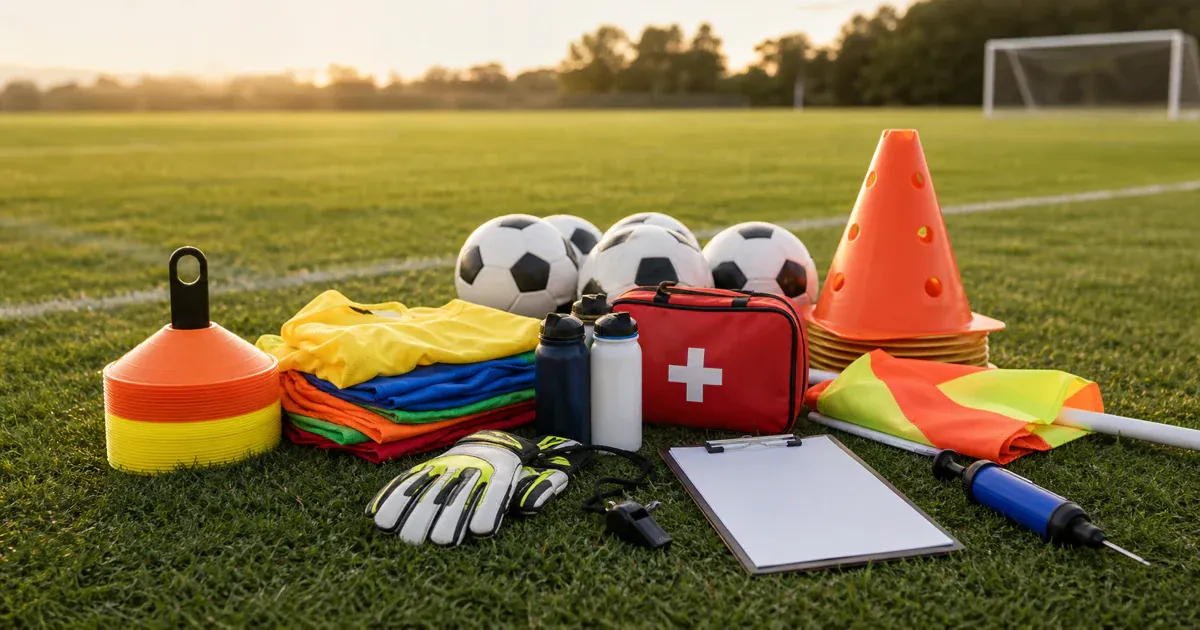
Most equipment gaps at a youth football tournament do not show up in planning meetings. They show up ten minutes before kick-off, when nobody can find a working pump, the only whistle belongs to one exhausted referee running between three pitches, or a portable goal tips over because nobody bought anchors.
None of that equipment is expensive or hard to find. It just needs to be on the list before the season, not remembered while parents are already arriving.
This checklist covers 25 items that come up again and again once a tournament grows beyond a single team bringing its own kit bag: officiating gear, pitch setup, balls and hydration, safety supplies, and the organiser-side extras that keep a multi-pitch day running without a mid-morning improvisation. Not every event needs all 25. A single-pitch Saturday festival and a three-day, ten-pitch regional tournament are solving different problems, and the size guide further down explains where to draw the line.
The 25 essentials at a glance
Match officiating and timing
- Referee whistle: audible over a full-size pitch and a noisy sideline
- Referee card set: red and yellow cards for every official on duty
- Assistant referee flags: offside and touchline signals for the line
- Coach's stopwatch: a backup timer independent of any phone
- Tactical clipboard: line-ups, substitutions and quick team talks
- Manual scoreboard: a visible score when there is no electronic display
Pitch and goal setup
- Corner flags: mark the four corners on any marked or unmarked pitch
- Portable goals: quick to pitch and move between age-group games
- Ground anchors: stop a light goal frame tipping or blowing over
- Training cones: warm-up zones, boundary markers and drill grids
- Line-marking spray: touch up faded lines on a borrowed or public pitch
Balls, kit and hydration
- Match balls: enough approved balls and checked spares per pitch
- Ball pump with needles: because a flat ball is the easiest delay to avoid
- Training bibs: tell two similarly coloured kits apart at a glance
- Mesh ball bag: keep match and warm-up balls together and countable
- Team water bottle carrier: hydration at the bench without ten loose bottles
Player safety and welfare
- Sports first-aid kit: stocked for the age group and the number of pitches
- Instant cold packs: immediate treatment for knocks and swelling
- Sun protection spray: an all-day outdoor event in direct sun
Organiser command post
- Wheeled equipment bag: one case per pitch instead of a loose pile
- Pop-up canopy tent: shade for the first-aid table, results desk or officials
- Folding table: registration, results and the scorer's table
- Two-way radios: faster than a phone call when a pitch needs help
- Megaphone: schedule changes and team calls across a busy venue
- Hi-vis staff vests: parents and coaches can find a steward instantly
Match equipment against the size of your tournament
A five-team, one-pitch festival and a sixteen-team, four-pitch weekend tournament do not need the same equipment budget, and buying for the wrong one wastes money either way.
For a single-pitch local event, you can usually get away with one referee kit, one first-aid kit, one set of goals and anchors, a mesh bag of match and spare balls, and a folding table for registration and results. A stopwatch and a printed card of fixtures cover timing and scheduling without anything electronic.
For a multi-pitch tournament, duplicate the pitch-level kit rather than sharing it. Two pitches running at the same time cannot share one pump, one set of corner flags or one whistle without someone standing idle waiting for equipment to be handed over. Keep a central desk with the spares: extra balls, a spare pump, extra cold packs, chargers for the radios and the master schedule.
For a full-day or multi-day event, add redundancy on top of duplication. A whistle can be dropped in mud, a pump needle can snap, and a canopy can blow over in wind that was fine in the morning. Pack at least one spare of every small, easily lost item, and assign one volunteer to own the equipment inventory from setup to pack-down.
Match officiating and timing
1. Referee whistle
A whistle only matters when every player and coach on a busy pitch can actually hear it over parents, other games and general noise. The Fox 40 Classic referee whistle is the whistle most match officials already carry, and it is worth keeping two or three spares in the officials' bag rather than assuming every volunteer referee owns one.
Pealess whistle designs like this one keep working when they get wet or muddy, which matters more at a youth tournament than most organisers expect.
2. Referee card set
Even at a friendly, low-stakes youth level, a referee red and yellow card set gives officials a clear, visible way to manage a game rather than relying on a shouted warning nobody quite hears. Keep a set with every match official rather than expecting one card set to be passed between pitches between games.
3. Assistant referee flags
Once a tournament runs proper matches rather than small-sided festival football, someone needs to signal offside, throw-ins and out-of-play decisions from the line. A pair of assistant referee flags turns a parent volunteer into a genuinely useful lineperson, provided they get a two-minute briefing on the signals beforehand.
4. Coach's stopwatch
Phones are an unreliable match timer. They ring, they run out of battery at the worst moment, and a screen glare in bright sun is hard to read at a glance. A dedicated coach's stopwatch at the halfway line removes that uncertainty and gives every official the same start and stop reference.
5. Tactical clipboard
A dry-erase tactical clipboard earns its place in a coach's bag long before match day, but it is just as useful for tournament organisers briefing pitch volunteers on rotations, substitution windows and time-keeping duties. Wipe it clean between games rather than trying to remember which notes belong to which fixture.
6. Manual scoreboard
Not every pitch has power for an electronic display, and a portable manual flip scoreboard solves that without needing a battery or a phone screen held up at the sideline. It also settles the inevitable disagreement over the current score faster than asking around.
Pitch and goal setup
7. Corner flags
A set of corner flags does more than mark the four corners for a proper match. On a public park pitch with faded or missing lines, they give players an unambiguous reference for where the field of play actually ends.
8. Portable goals
Portable pop-up goals let a single volunteer set up or move a pitch between age groups without a van and two adults wrestling a permanent frame. Choose a size that matches the age group actually playing rather than borrowing whatever goal happened to be in the shed.
9. Ground anchors
A light pop-up goal that is not pinned down will move in wind or when a ball hits the frame, and a moving goal near young players is a genuine safety problem, not a minor inconvenience. Ground anchors are inexpensive relative to that risk and should go down with every goal, every time, even on a still day.
10. Training cones
Disc cones mark warm-up zones, keep queuing teams away from the pitch in play, and section off drill areas without needing anything permanent. Bright colours matter more than the exact size when the aim is simply visibility from a distance.
11. Line-marking spray
Borrowed school fields and public parks rarely have crisp lines on the day you need them. A can of athletic field line-marking spray touches up a faded touchline or penalty area in minutes and washes out with normal mowing, unlike a permanent paint.
Balls, kit and hydration
12. Match balls
Every pitch needs an agreed match ball and at least one checked spare, and it is worth deciding the size and model in advance rather than letting whichever team turns up first supply the ball. Our full comparison of current match and training footballs covers FIFA quality marks, construction and the right size for different age groups if you have not settled on one yet.
13. Ball pump with needles
A ball pump with spare needles is one of the cheapest items on this list and also one of the most common causes of a delayed kick-off when it is missing. Keep it with the match balls, not in a separate bag that someone forgets to bring.
14. Training bibs
When two teams turn up in similar colours, which happens more often than organisers expect, a set of training bibs is the fastest fix. Keep at least two colours available at the results desk so a clash never delays a fixture.
15. Mesh ball bag
A mesh ball bag keeps match and warm-up balls together, easy to count at the start and end of the day, and easy to carry between pitches without loose balls rolling off in every direction.
16. Team water bottle carrier
A team water bottle carrier at each bench keeps hydration organised rather than a scattered pile of bottles nobody can identify as their own, particularly useful during a hot, all-day tournament with back-to-back matches.
Player safety and welfare
17. Sports first-aid kit
Every pitch, or at minimum every venue, needs an accessible sports first-aid kit stocked for the number of players and the length of the day. Check it before the season starts, not the morning of the tournament, and replace anything opened, expired or used up from the last event.
18. Instant cold packs
Instant cold packs need no freezer and activate in seconds, which matters when the nearest fridge is a ten-minute walk from the pitch. Keep several in every first-aid kit rather than one shared pack for the whole venue.
19. Sun protection spray
An outdoor youth tournament often runs for six or more hours in direct sun, and a sport sunscreen spray at the registration or first-aid table costs very little next to the discomfort of sunburned players and volunteers by the final round.
Organiser command post
20. Wheeled equipment bag
A wheeled equipment bag per pitch keeps cones, flags, anchors and spares in one place that one person can move without a second trip to the car. Loose equipment scattered across a venue is the easiest way to lose something before the next tournament.
21. Pop-up canopy tent
A pop-up canopy tent gives the first-aid table, results desk or match officials somewhere out of direct sun or rain to work from for a full day. It is a small purchase that makes a noticeable difference to volunteers standing in the same spot for hours.
22. Folding table
A folding table at registration and results turns a pile of paperwork on someone's knee into an actual desk. Bring one more than you think you need; a second table for results relieves pressure on registration during the busy first hour.
23. Two-way radios
When more than one pitch is running, a set of two-way radios gets an urgent message to the right person faster than a phone call, particularly when signal is patchy at an outdoor venue. Agree on simple channel rules in advance so radio traffic stays short and useful.
24. Megaphone
A megaphone carries schedule changes, team calls and safety announcements across a venue where a normal speaking voice does not reach the far pitch. Use it for genuinely important announcements rather than constant chatter, so people still listen when it matters.
25. Hi-vis staff vests
Hi-vis staff vests let a parent with a lost child, an injured player or a scheduling question spot a steward immediately in a crowd, instead of guessing who is actually running the event. Keep them on for the whole day, not just at the entrance.
A few equipment mistakes worth avoiding
Buying one of everything instead of one per pitch
A single whistle, pump or set of corner flags works for a one-pitch event. Once a second pitch runs at the same time, duplicate the kit rather than sending a volunteer jogging between pitches to borrow it.
Skipping ground anchors on a calm morning
Wind picks up during the day more often than organisers plan for, and a moving goal frame near young players is not a risk worth taking to save five minutes of setup.
Treating the first-aid kit as a box you buy once
Contents get used, go out of date and go missing between events. Check the kit before every tournament rather than assuming last season's kit is still complete.
Relying entirely on phones for timing and communication
A dead battery, a bad signal or a cracked screen should not be able to stop a match or delay a schedule change. A stopwatch, a printed fixture list and a set of radios all work when a phone does not.
Leaving equipment unlabelled and unassigned
Give one volunteer clear ownership of the equipment inventory, from loading the car to counting everything back in at the end of the day. Shared responsibility for equipment usually means nobody actually checks it.
Quick packing list by category
Officiating and timing: referee whistles and spares, red and yellow cards, assistant referee flags, stopwatches, tactical clipboard, manual scoreboard.
Pitch and goals: corner flags, portable goals, ground anchors, training cones, line-marking spray.
Balls and kit: match balls and spares, ball pump and needles, training bibs, mesh ball bag, water bottle carriers.
Safety and welfare: first-aid kit, instant cold packs, sun protection spray, drinking water.
Organiser command post: wheeled equipment bags, pop-up canopy, folding tables, two-way radios, megaphone, hi-vis staff vests.
Run through this list when packing the car, again when unloading at the venue, and once more at pack-down. Each check tends to catch a different missing item.
Organise the games once the kit is sorted
Equipment stops avoidable delays on the day. It does not replace a schedule that gives every team a fair, well-spaced set of matches. Fixture.cc's free football fixture generator builds round-robin fixtures, group stages and knockout brackets in a few minutes, without a spreadsheet, so the pitches, referees and equipment above have an actual timetable to run against.
Frequently asked questions
What is the minimum equipment needed to run a youth football tournament?
At a minimum, plan for match balls and a pump, corner flags, goals with anchors, a first-aid kit, a whistle and card set for officials, and a table for registration and results. Everything else on this list becomes more useful as the number of pitches, teams or hours in the day grows.
How many footballs should I bring to a youth tournament?
Plan for at least one approved match ball per pitch plus a checked spare, and keep separate warm-up balls so the match balls are never accidentally used or misplaced during a game.
What ball size do youth football tournaments use?
Younger age groups typically play with size 3 or size 4, while older teenagers and adults use size 5. Always confirm the size against the specific league or tournament rules rather than assuming, since requirements vary by association and age group.
Should organisers provide referee whistles and cards, or expect referees to bring their own?
Most volunteer referees will bring their own whistle, but a tournament should still keep spares. Cards, in particular, are easy to forget or leave in another bag, so a spare set at the officials' table avoids a delay.
How do you stop a portable football goal from tipping over?
Use ground anchors or stakes suited to the surface, check them before every game rather than only at setup, and never leave an unanchored goal unattended where players can climb on or collide with it.
What is the best way to keep score without an electronic scoreboard?
A portable manual flip scoreboard placed where both teams and the sideline can see it works for the vast majority of youth tournaments. Pair it with a printed score sheet so there is a written record if the physical scoreboard is knocked or reset by mistake.
Bringing it together
None of these 25 items need to be expensive or difficult to source, and most youth football tournaments never need all of them at once. What matters is matching the list to your event: a single-pitch Saturday festival needs the core officiating, pitch and safety kit; a multi-pitch weekend tournament needs that kit duplicated per pitch, plus the organiser-side extras that keep communication and admin running across the whole venue.
Pack early, check the first-aid kit and ground anchors before every event without exception, and give one person clear ownership of the equipment list from loading the car to counting everything back in at the end of the day.
Our editorial process
How we research and review our content
Our research process depends on the subject. We select the sources that can answer the article's actual question, cross-check important claims, and distinguish documented facts from editorial judgement.
- Practical context and direct experience
- We draw on our team's experience of sports, equipment, and organising competitions when it is relevant. Direct use informs our judgement only where it actually occurred; we do not present research as hands-on testing.
- Primary and authoritative sources
- Depending on the topic, we consult governing-body rules, official guidance, manufacturer specifications and manuals, standards, technical documentation, and other first-party sources.
- Independent and public evidence
- For comparisons and recommendations, we may examine specialist reviews, public customer feedback, retailer information, ratings, and recurring real-world issues. We cross-check patterns and never treat one comment or score as proof.
- Editorial review and updates
- We compare the available evidence with the reader's likely needs, explain uncertainty and trade-offs, verify important claims, and update content when rules, products, features, or source information change.
Share this article
Send this guide to someone who might find it useful.

About the author
Fixture.cc editorial team
The Fixture.cc editorial team is a global group of sports enthusiasts creating practical, trustworthy guides for sports fans, competition organisers, coaches, and teachers.
View editorial profileKeep reading
Related articles
How to Choose the Right Bowling Ball Weight
Learn how to choose a bowling ball weight that you can control, repeat and use comfortably, with practical advice for adults, children and seniors.
What Is a Bye in Sports? Rules, Examples and Calculation
Learn what a bye means in knockout, round-robin and Swiss tournaments, how many byes a bracket needs, and how to award them fairly.
Best Cameras for Recording Youth Football Matches in 2026
Five cameras for filming youth football from the sideline, chosen for battery life, wide field of view, stabilization, and standing up to a wet touchline.