5 Best Pickleball Paddles for Every Playing Style
Five current pickleball paddles for control, value, quick handling, power and premium play, with practical advice on choosing the right shape.
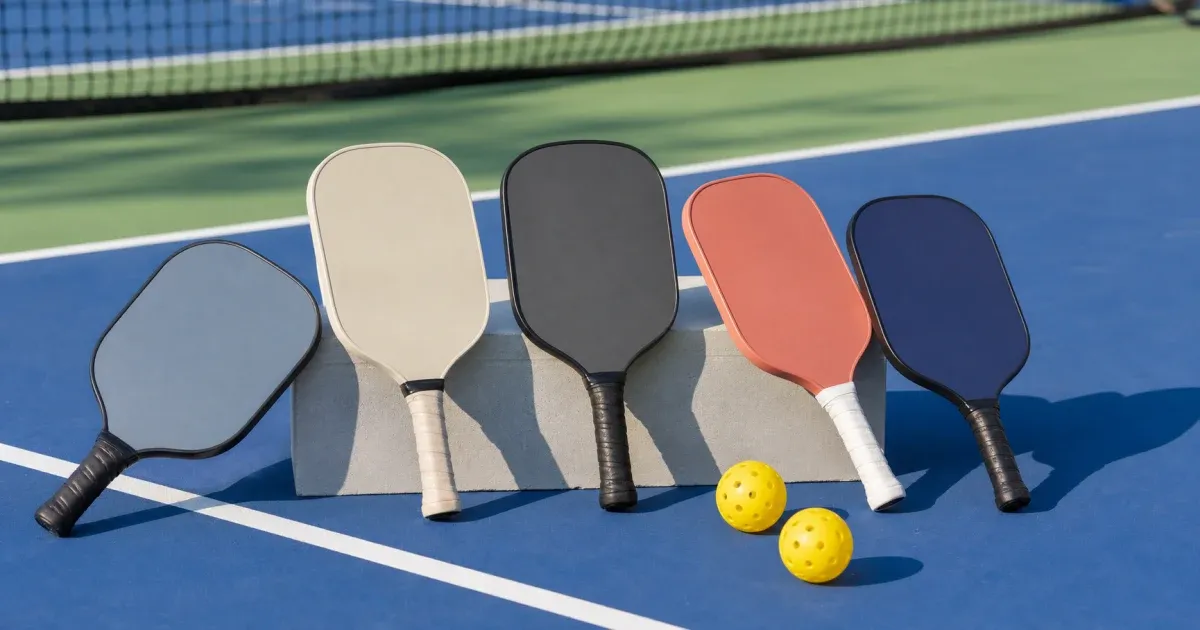
The wrong pickleball paddle often feels impressive for ten minutes and tiring for the rest of the match.
Extra power is easy to notice in a shop or during warm-up. What matters over three games is whether you can soften a return into the kitchen, reset a fast ball under pressure and move the paddle quickly enough during a hands battle. Shape, core thickness, weight and handle length all change that balance, so the most expensive paddle is not automatically the best one for your game.
For most players moving beyond a basic starter set, we would choose the SLK HALO Control Max. Its broad face, 16 mm core and manageable weight make control easier without leaving you with a paddle that feels lifeless. Choose the Paddletek Bantam TS-5 if quick handling matters most, or the Franklin C45 Hybrid 14mm if you already control the soft game and want a firmer response.
The five best pickleball paddles at a glance
SLK HALO Control Max
The safest all-round choice for a generous sweet spot, predictable control and useful spin
Vatic Pro PRISM Flash 16mm
Raw-carbon control and a long handle without paying for a top-tier professional model
Paddletek Bantam TS-5
Fast through the air and easy to position during quick exchanges at the kitchen line
Franklin C45 Hybrid 14mm
A firmer, elongated carbon paddle for players who create their own control and want more pop
JOOLA Perseus Pro IV 16mm
Premium elongated performance for experienced players who want reach, stability and a long handle
What actually changes how a pickleball paddle plays?
A wider face is usually more forgiving
Wide or standard-shaped paddles put more surface area around the centre of the face. That does not make every mishit disappear, but it gives developing players more margin when contact drifts towards the edge. Elongated paddles trade some of that width for extra reach, leverage and handle space, which can suit singles players and two-handed backhands.
If you are unsure, start with a standard or hybrid shape. Reach is useful, but a paddle you consistently meet near the centre will normally produce a better ball than a longer paddle you struggle to position.
A thicker core normally softens the response
A 16 mm core generally gives the ball more time on the face and makes blocks, drops and resets easier to control. A 12.7 mm or 14 mm core tends to feel quicker and firmer, with more immediate rebound. Construction and face material also matter, so thickness is a guide rather than a complete performance rating.
Newer players often benefit from 16 mm. Players with compact strokes who already have reliable touch may prefer the direct response of a thinner core.
Static weight is only part of the handling story
Two paddles can weigh the same on a scale and feel different in motion. An elongated paddle with more mass towards the tip takes more effort to accelerate and redirect than a balanced standard shape. That extra momentum can help on serves and drives, but it may slow your hands during fast volleys.
Grip size matters too. A grip that is too large can make wrist movement and grip changes awkward, while one that is too small may encourage you to squeeze harder than necessary. An overgrip can build a handle up; making an oversized handle smaller is much harder.
1. SLK HALO Control Max: the best choice for most players
The SLK HALO Control Max is the paddle we would hand to someone who has learned the rules, can sustain a rally and now wants equipment that will remain useful as their technique improves.
Selkirk gives the Max shape a 16-inch (40.6 cm) length and 7.85-inch (19.9 cm) width, with a 16 mm polymer honeycomb core and an 18K carbon-fibre face. The listed 7.7–8.0 oz (218–227 g) range keeps it manageable, while the wider face gives you more room than an elongated paddle when a defensive contact is late or off-centre. Its 4.85-inch (12.3 cm) handle is comfortable for a conventional one-handed grip but less accommodating for a full two-handed backhand.
The reason to buy it is control rather than free power. The thicker core and broad face help with drops, resets and blocks, while the textured surface gives you scope to develop spin. A strong player who wants maximum reach and heavy drives may find the Max shape too conservative; most recreational and developing players will appreciate that it makes the difficult parts of pickleball less demanding.
2. Vatic Pro PRISM Flash 16mm: the value pick for touch and spin
The Vatic Pro PRISM Flash 16mm makes sense when you want a serious raw-carbon paddle but do not need the explosive rebound or price of a current flagship model.
Its 16.2-inch (41.1 cm) by 7.7-inch (19.6 cm) hybrid face sits between a widebody and a fully elongated shape. The raw T700 carbon surface, 16 mm polymer honeycomb core, foam-injected edge and 5.3-inch (13.5 cm) standard handle are aimed at feel and a stable sweet spot. A longer 5.75-inch (14.6 cm) handle is also offered, but check the exact listing because the two versions suit different grips.
The softer response is helpful for third-shot drops and absorbing pace, but it will not give you the easiest put-away power from a short swing. That is a fair trade for a player whose points are lost through balls popping up rather than through a lack of speed. International availability and import costs can vary, so compare the delivered price with locally stocked alternatives before treating it as the automatic value winner.
3. Paddletek Bantam TS-5: the quick-handling option
Some players do not need a larger paddle. They need one that reaches the right place sooner. The Paddletek Bantam TS-5 is built around that idea.
At 7.0–7.5 oz (198–213 g), it is noticeably lighter than many performance paddles. The standard 16-inch (40.6 cm) by 8-inch (20.3 cm) face and 5-inch (12.7 cm) handle keep it compact, while the 12.7 mm Bantam PolyCore gives the ball a firmer exit than the 16 mm control paddles above. That combination suits quick counters, players with a shorter swing and anyone who dislikes a head-heavy feel.
Low weight is not a free upgrade. A lighter paddle provides less mass against a hard incoming ball and can feel less stable when contact moves away from the centre. It may also ask you to supply more of your own depth from the baseline. Choose it for manoeuvrability, not because lightest automatically means easiest.
4. Franklin C45 Hybrid 14mm: for players ready for more pop
Once your drops and resets are reliable, a softer paddle can start to feel as though it is holding back your attacks. The Franklin C45 Hybrid 14mm is the step in the other direction: firmer, longer and more willing to send the ball through the court.
Franklin lists the Hybrid at 16.3 inches (41.4 cm) long, 7.6 inches (19.3 cm) wide and 7.6–7.9 oz (215–224 g), with a 5.7-inch (14.5 cm) handle. Its double-thermoformed build, T700 carbon face and 14 mm PowerFlex core are designed for a more immediate response and a handle long enough for two hands.
That pop rewards an assertive drive and quick counter, but it also makes a poorly softened reset more likely to sit up. Beginners who are still learning to take pace off the ball will usually be better served by the SLK HALO Control Max or Vatic Pro PRISM Flash 16mm. Choose the C45 when control is already a skill you bring to the paddle.
5. JOOLA Perseus Pro IV 16mm: the premium elongated choice
The JOOLA Perseus Pro IV 16mm is for an experienced player who knows why they want an elongated paddle. It is not the sensible first purchase simply because it carries a professional name and a premium specification.
The 16.5-inch (41.9 cm) by 7.5-inch (19.1 cm) shape gives extra reach and leverage, while the 5.5-inch (14 cm) handle supports a two-handed backhand. JOOLA lists an average weight of 8.1 oz (230 g), a 16 mm core and textured carbon-fibre surface. The company also identifies this version as USA Pickleball and UPA-A certified, though competitive players should still check the current event rules and approved-equipment database before a tournament.
The length and weight bring stability and authority when contact is clean. They also make the paddle slower to redirect than a light standard shape, and the narrower face gives you less margin on rushed blocks. If those trade-offs sound like problems rather than acceptable costs, save the premium and buy the more forgiving option.
Which pickleball paddle should you buy?
Start with the problem you actually want the paddle to solve:
- Choose the SLK HALO Control Max if you want the safest balance of forgiveness, control and spin.
- Choose the Vatic Pro PRISM Flash 16mm if soft-game control and value matter more than easy power.
- Choose the Paddletek Bantam TS-5 if quick hands and low swing effort are your priorities.
- Choose the Franklin C45 Hybrid 14mm if you already have touch and want a firmer, more aggressive response.
- Choose the JOOLA Perseus Pro IV 16mm if you are an experienced player who specifically wants premium elongated performance.
If you are still deciding whether pickleball suits you better than another racket sport, our padel, tennis and pickleball comparison explains the court, rules and learning curve before you spend more on equipment.
Mistakes that lead to the wrong paddle
Buying power before you can control the kitchen
Most recreational points are not lost because a drive was a little too slow. They are lost because a return floats high, a reset travels too deep or a dink becomes attackable. A powerful paddle can make those misses worse. Build reliable touch first, then decide whether you need more speed.
Choosing an elongated shape only for extra reach
The extra length looks useful, but it comes with a narrower face and usually more effort in quick exchanges. Players who rarely use a two-handed backhand or play singles may gain more from a wider sweet spot than from another half-inch of reach.
Assuming approval can never change
Tournament equipment rules and approval lists can change. If you enter sanctioned competition, check the exact model and thickness in the event's current approved-equipment database rather than relying on an old product image or a marketplace description.
Frequently asked questions
What is the best pickleball paddle for most intermediate players?
The SLK HALO Control Max is the safest recommendation here because its broad face and 16 mm core help with control without making the paddle cumbersome. Players who already prefer an elongated shape may find the Vatic Pro PRISM Flash 16mm a better fit.
Is a 14 mm or 16 mm pickleball paddle better?
A 16 mm paddle generally feels softer and more controlled, while a 14 mm paddle usually rebounds faster and feels more direct. Beginners and control-first players often prefer 16 mm; confident attackers may prefer 14 mm. Construction still matters, so thickness should not be the only deciding factor.
How heavy should a pickleball paddle be?
Many players settle between roughly 7.5 and 8.2 oz (213–232 g). Lighter paddles are easier to move quickly but can be less stable against pace. Heavier paddles carry more momentum but demand more effort over a long session. Balance and swing feel matter as much as the number on the scale.
Do I need a USA Pickleball-approved paddle?
Not for casual play. Approval matters when an event uses USA Pickleball equipment rules. Because status can change and differently named versions may exist, competitive players should search the current database for the exact model before entering a sanctioned tournament.
Our final pick
The SLK HALO Control Max is the best pickleball paddle for the widest range of players in this guide. Its shape gives you useful margin on imperfect contact, the 16 mm core supports the soft game, and the carbon face leaves enough spin and precision to grow into.
Do not pay for the JOOLA Perseus Pro IV 16mm unless you know you want its length and premium construction. Do not choose the Paddletek Bantam TS-5 unless speed in the hand matters more than stability. The best paddle is the one whose compromises match your game, not the one with the longest feature list.
Our editorial process
How we research and review our content
Our research process depends on the subject. We select the sources that can answer the article's actual question, cross-check important claims, and distinguish documented facts from editorial judgement.
- Practical context and direct experience
- We draw on our team's experience of sports, equipment, and organising competitions when it is relevant. Direct use informs our judgement only where it actually occurred; we do not present research as hands-on testing.
- Primary and authoritative sources
- Depending on the topic, we consult governing-body rules, official guidance, manufacturer specifications and manuals, standards, technical documentation, and other first-party sources.
- Independent and public evidence
- For comparisons and recommendations, we may examine specialist reviews, public customer feedback, retailer information, ratings, and recurring real-world issues. We cross-check patterns and never treat one comment or score as proof.
- Editorial review and updates
- We compare the available evidence with the reader's likely needs, explain uncertainty and trade-offs, verify important claims, and update content when rules, products, features, or source information change.
Share this article
Send this guide to someone who might find it useful.

About the author
Fixture.cc editorial team
The Fixture.cc editorial team is a global group of sports enthusiasts creating practical, trustworthy guides for sports fans, competition organisers, coaches, and teachers.
View editorial profileKeep reading
Related articles
Best Cameras for Recording Youth Football Matches in 2026
Five cameras for filming youth football from the sideline, chosen for battery life, wide field of view, stabilization, and standing up to a wet touchline.

5 Best Budget Gaming Monitors Under USD 200 for Esports
Five gaming monitors under USD 200 with refresh rates and response times suited to competitive esports, from compact displays to 1440p options.
Best Portable Pickleball Court Lights for Night Play
Five portable lighting options for pickleball after dark, from driveway drills to full-court club play, with practical glare and setup advice.