How to Choose the Right Bowling Ball Weight
Learn how to choose a bowling ball weight that you can control, repeat and use comfortably, with practical advice for adults, children and seniors.
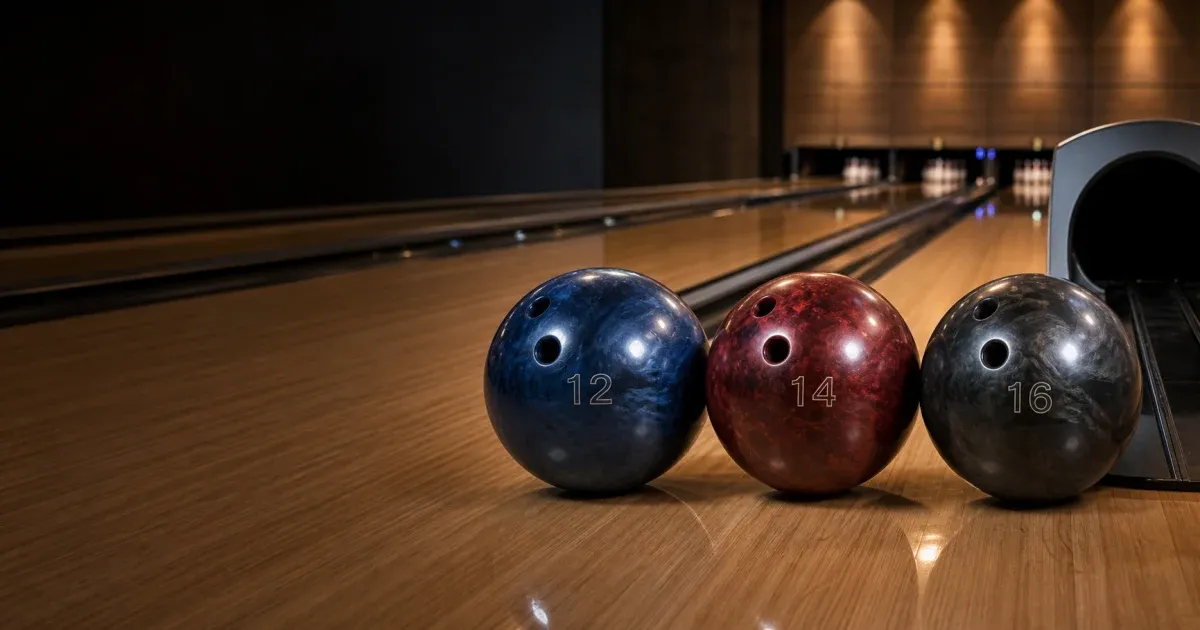
The right bowling ball weight is the heaviest ball you can control comfortably and repeatably, not the heaviest ball you can lift for a few seconds. If you have to squeeze the holes, rush your approach or protect a sore wrist, the ball is too heavy for the way you currently bowl.
For many adult bowlers, that eventually means somewhere around 14 to 16 pounds. It is not a target you have to reach, though. A well-delivered 13- or 14-pound ball is a better choice than a 16-pound ball that makes you lose balance and slow down. The familiar 10% rule is a useful starting point, but your strength, hand size, technique and physical comfort matter more.
Weight is only one part of choosing your equipment. If you are also comparing coverstocks and ball motion, read our guide to the best bowling balls for beginners and league play after working out which weight you can actually use.
Start with the 10% rule, then test it
The usual starting point is a ball weighing roughly 10% of your body weight, up to the 16-pound maximum. USA Bowling presents that as a guideline rather than a law, with adjustments for a bowler's size, strength and ability. The USA Bowling coaching guide also warns that a ball that is too heavy can make a bowler squeeze and move erratically, while a ball that is too light can encourage them to manipulate the swing.
That gives you a sensible range to try, not a number to obey. Someone who weighs 150 pounds does not automatically need a 15-pound ball, particularly if they are new to the game, have a smaller hand or are returning after an injury. Someone who weighs 200 pounds may still need a lighter ball if their release is not yet stable.
Use the rule to choose two or three house balls to test. Then judge what happens during a complete game, not only how the ball feels when you pick it up from the rack.
Why a custom fit can change the weight you need
A house ball is drilled for general use. The thumb and finger holes may be too large, too small or spaced poorly for your hand, so you often compensate by gripping harder. That extra tension makes the ball feel heavier and can change the timing of your swing.
A fitted ball should let your hand support the ball without clenching. The thumb should exit without sticking, the fingers should not feel pinched and the span should allow a relaxed hand position. A pro shop can measure the span and hole sizes, then watch how you hold and release the ball before drilling it.
This is why you should be careful when comparing a house-ball weight with the weight of a new ball. A house ball that feels manageable may be lighter than the ball you can use once the fit is correct. The opposite can also be true if the house ball happens to fit your hand unusually well. Test first, then let a qualified fitter help you decide whether a different weight makes sense.
The signs that a bowling ball is too heavy
Weight problems usually show up in your movement before they show up on the score sheet. Look for several signs together rather than reacting to one poor shot.
- You need to grip the thumb or fingers tightly to keep hold of the ball.
- Your shoulder lifts or your arm bends during the backswing.
- You rush your feet to catch up with the ball.
- You lose your balance at the foul line or cannot hold your finish.
- The ball speed drops sharply as the game continues.
- Your wrist, forearm, elbow or shoulder becomes painful or unusually tired.
- Your release becomes inconsistent even when your target and approach feel familiar.
Pain is a reason to stop and reassess, not something to bowl through. A poor fit can create many of the same symptoms, so do not assume that simply dropping one pound will solve the problem. If discomfort continues, ask a pro shop operator or qualified coach to check the fit and your release.
The signs that a ball is too light
Going lighter solves some control problems, but it can introduce others. A ball may be too light if you can easily accelerate it with your hand, change its direction during the swing or finish the shot without any sense of weight moving through your body.
You might also find that you throw the ball rather than roll it, pull it across your body or rush the downswing because the ball gives you no useful rhythm. A lighter ball is not automatically easier to control if it encourages you to steer it.
The goal is a smooth pendulum-like swing. You should feel the ball's weight, but you should not have to fight it. If you can maintain the same approach, release and finish with a slightly heavier ball, test it rather than ruling it out because it feels different in your hand.
How adults should choose a ball weight
Adult bowlers often settle between 14 and 16 pounds, but the useful range is wider than that. Your best choice depends on whether you bowl once a month, practise several games a week, compete in a league or manage an existing wrist or shoulder problem.
For a new adult bowler, start with a weight that allows a relaxed release and a balanced finish for a full game. Do not choose 16 pounds simply because it is the maximum legal weight. If 14 pounds lets you repeat your timing and keep your speed late in the session, it is the stronger practical choice.
Experienced bowlers can also need to move down in weight. A change in fitness, a hand or shoulder injury, or a longer tournament format can make a previously comfortable ball too demanding. There is no performance prize for staying at a weight that damages your technique.
Choosing a bowling ball weight for children
For children, control and safety matter more than matching an adult standard. The 10% rule can be a rough reference, and age-based suggestions are sometimes used for younger bowlers, but neither replaces observation. A child should be able to lift, swing and release the ball without leaning away from it or using both hands to force the motion.
Try a few weights and watch the whole delivery. The child should be able to keep their head and upper body reasonably stable, release without dropping the ball and finish without pain. As they grow, check the fit and weight again rather than assuming the same ball remains suitable.
The USBC equipment specification manual states that an approved bowling ball cannot exceed 16 pounds and has no minimum weight requirement. That maximum applies to competition equipment; it does not mean a young bowler should work towards it.
Choosing a weight for seniors or bowlers with physical limitations
Age alone does not determine the correct weight. A strong, active older bowler may use a heavier ball comfortably, while another bowler may need to reduce weight because of arthritis, reduced grip strength or a previous injury.
Choose the weight that allows a relaxed hand and a repeatable release. If a bowler has pain, numbness or weakness, professional medical advice is more appropriate than a generic bowling chart. Equipment changes can help, but they should not be used to diagnose or ignore an injury.
Test the weight over a full game
The best test is simple: use a few different house balls and bowl enough frames to see how your technique changes as you tire.
- Begin with the weight that feels naturally manageable.
- Bowl several shots while watching your grip, backswing and finish.
- Test the next heavier ball only if you can keep the same basic movement.
- Compare how both weights feel after a full game or practice session.
- Choose the heaviest option that still allows a relaxed, repeatable delivery.
Do not judge only by pin noise or one high-scoring frame. A heavier ball may feel impressive when everything lines up, but consistent speed and accuracy are more useful over a league night. Likewise, a lighter ball is not automatically right because it feels easy to carry between shots.
Weight is separate from ball reaction
Changing weight is not the same as changing the way a ball hooks. Coverstock, surface, core, drilling layout, release speed and lane oil all affect ball motion. If your current ball is hooking too early or not enough, the answer may be a different surface or coverstock rather than a heavier or lighter shell.
This matters when buying your first personal ball. First choose a weight that fits your delivery, then compare balls suited to the lanes you normally play. Our beginner and league bowling-ball guide explains the difference between reactive and polyester balls, along with how lane conditions affect the choice.
Common mistakes to avoid
Choosing the heaviest ball because it is supposed to hit harder
The maximum legal weight is not a recommendation. If the ball slows you down or makes you miss your finish, the theoretical advantage is irrelevant to your actual delivery.
Treating body weight as a precise formula
Ten percent is a starting point, not a fitting system. It does not measure grip strength, hand size, mobility, technique or how your body feels after several games.
Comparing an undrilled ball with a badly fitting house ball
The hand fit can change how heavy a ball feels. Choose the weight with the help of a proper fitting rather than relying only on the label of a house ball.
Changing weight before checking the fit
Thumbs that stick, finger holes that pinch and a span that stretches the hand can all look like weight problems. Check the fit before making a large change.
Ignoring fatigue
A ball that feels fine for three shots may be too heavy for a league session. Test it for long enough to reveal what happens when your grip and timing are no longer fresh.
Frequently asked questions
Is a 15-pound bowling ball too heavy for a beginner?
Not necessarily. Many adult beginners can use 14 or 15 pounds comfortably, but the correct choice depends on your strength, hand fit, release and ability to repeat the shot. If 15 pounds causes strain or loss of balance, choose a lighter ball.
Is the 10% rule accurate for bowling ball weight?
It is a useful starting estimate, not a precise rule. Adjust it for your strength, size, technique, hand fit and physical limitations, then test the weight over a full game.
Should children use a bowling ball equal to their age?
Age-based guidance can provide a rough starting point, but a child should be able to lift, swing and release the ball comfortably. Test the delivery and reassess the weight as the child grows.
Can a proper fit make a bowling ball feel lighter?
Yes. A ball that fits your hand lets you hold it with less squeezing, so the same labelled weight may feel easier to control. Fit can also reveal that a house ball was too light or simply drilled poorly for your hand.
What is the heaviest legal bowling ball?
USBC equipment specifications set the maximum weight at 16 pounds and do not set a minimum weight. Legal maximum weight is different from the right weight for an individual bowler.
The practical answer
Choose the heaviest bowling ball you can swing, release and finish with comfortably for a complete session. Use the 10% guideline to choose your first weights, but let control, repeatability and physical comfort make the final decision.
Once you know the weight that suits you, compare the ball types and lane-condition advice in our guide to the best bowling balls for beginners and league play. The right weight gives that equipment choice a fair chance to work.
Our editorial process
How we research and review our content
Our research process depends on the subject. We select the sources that can answer the article's actual question, cross-check important claims, and distinguish documented facts from editorial judgement.
- Practical context and direct experience
- We draw on our team's experience of sports, equipment, and organising competitions when it is relevant. Direct use informs our judgement only where it actually occurred; we do not present research as hands-on testing.
- Primary and authoritative sources
- Depending on the topic, we consult governing-body rules, official guidance, manufacturer specifications and manuals, standards, technical documentation, and other first-party sources.
- Independent and public evidence
- For comparisons and recommendations, we may examine specialist reviews, public customer feedback, retailer information, ratings, and recurring real-world issues. We cross-check patterns and never treat one comment or score as proof.
- Editorial review and updates
- We compare the available evidence with the reader's likely needs, explain uncertainty and trade-offs, verify important claims, and update content when rules, products, features, or source information change.
Share this article
Send this guide to someone who might find it useful.

About the author
Fixture.cc editorial team
The Fixture.cc editorial team is a global group of sports enthusiasts creating practical, trustworthy guides for sports fans, competition organisers, coaches, and teachers.
View editorial profileKeep reading
Related articles

Youth Football Tournament Equipment Checklist: 25 Essentials for a Professional Match Day
A practical youth football tournament equipment checklist covering officiating gear, pitch setup, safety kit, hydration and the operational extras match day needs.
What Is a Bye in Sports? Rules, Examples and Calculation
Learn what a bye means in knockout, round-robin and Swiss tournaments, how many byes a bracket needs, and how to award them fairly.
Best Cameras for Recording Youth Football Matches in 2026
Five cameras for filming youth football from the sideline, chosen for battery life, wide field of view, stabilization, and standing up to a wet touchline.