What Is a Bye in Sports? Rules, Examples and Calculation
Learn what a bye means in knockout, round-robin and Swiss tournaments, how many byes a bracket needs, and how to award them fairly.
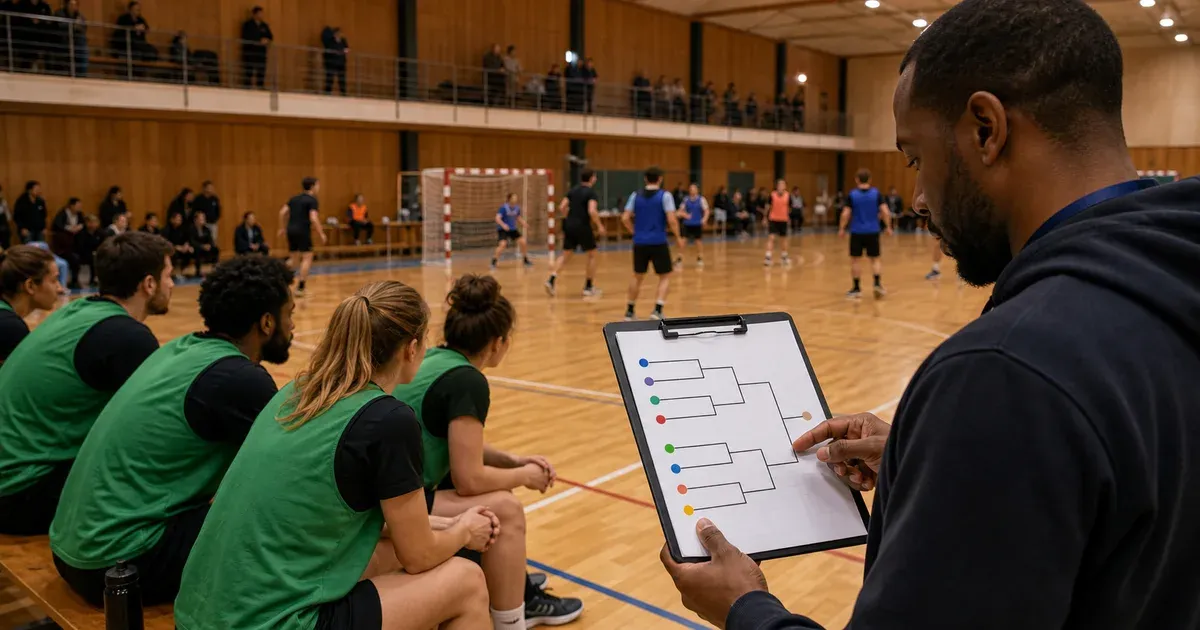
You have ten teams and space for a 16-team knockout bracket. Six teams have no first-round opponent. They have not won a match, and nobody has forfeited against them: they simply advance to the next round. That is a bye.
A bye is a scheduled absence of a match. In a knockout, it means automatic advancement. In a round-robin, it normally means a rest round. In a Swiss tournament, it means one participant is left unpaired and may receive points under the published rules. The same word describes different outcomes, so organisers need to say exactly what a bye means before play starts.
For a knockout, the calculation is simple: subtract the number of entrants from the next power-of-two bracket size. Ten entrants fit into a 16-place bracket, so the opening round needs six byes. You can check the match count and likely running time with the free tournament duration calculator, then create the draw with the tournament bracket generator.
A bye is not the same as a walkover or a forfeit
These terms are often mixed together, but they describe different situations:
| Term | What happened | Recorded as a match? |
|---|---|---|
| Bye | The competition structure provides no opponent | No |
| Walkover | A match was expected, but one side cannot or does not contest it | Depends on the competition rules |
| Forfeit | The rules impose an outcome, often for non-attendance or ineligibility | Usually, using the published result policy |
| Rest round | A team has no fixture in that round | No |
The distinction matters. A knockout bye should not be recorded as a scored victory, and it should not give the advancing team a defeated opponent. A walkover or forfeit may affect records, tie-breakers or disciplinary reporting according to the sport's rules.
Official rules use the same basic distinction. The USTA defines a bye as an open draw line caused by too few entrants, leaving the recipient without a first-round match, while World Archery states that a match with a bye does not take place and the athlete or team advances. See the USTA tournament rules and World Archery rules.
Why knockout brackets need byes
A balanced elimination bracket halves cleanly: 32 becomes 16, then eight, four, two and one champion. That is why powers of two, such as 2, 4, 8, 16, 32 and 64, fit knockout brackets without empty positions.
When the number of entrants is not a power of two, the draw can be placed inside the next larger power-of-two bracket. The empty positions become byes.
Use this calculation:
Number of byes = next power of two − number of entrants
To calculate it for any field:
- Find the next bracket size in the sequence 2, 4, 8, 16, 32 or 64.
- Subtract the number of entrants from that bracket size.
- The result is the number of first-round byes.
- The remaining entrants play enough opening matches to leave a complete next round.
| Entrants | Bracket size | Byes | Matches in the opening round |
|---|---|---|---|
| 5 | 8 | 3 | 1 |
| 6 | 8 | 2 | 2 |
| 10 | 16 | 6 | 2 |
| 12 | 16 | 4 | 4 |
| 24 | 32 | 8 | 8 |
For ten teams, a 16-position bracket has six empty positions. Six teams advance without playing, while the other four teams play two opening-round matches. The eight remaining teams then form the quarter-finals.
This does not change the total number of contested matches in a single-elimination tournament. Eliminating all but one of N teams always takes N − 1 decisive matches. A ten-team knockout still needs nine played matches; the byes only change when each team enters.
Who should receive a knockout bye?
There is no single allocation method for every sport, but there must be a method that participants can understand before the draw.
Award byes to the highest seeds
This is the usual choice when the tournament has reliable rankings, qualification results or a previous league table. The strongest seed receives the first bye, followed by the next strongest, with seeds distributed across the bracket so the top two cannot meet before the final.
The advantage is intentional: qualification performance earns a safer route. World Archery, for example, places athletes into its match-play chart using qualification rankings.
Draw the byes randomly
A transparent random draw is suitable when entrants have no meaningful ranking. Draw every bracket position using the same process and let the empty positions determine who advances.
Do not claim the draw is random and then move teams away from inconvenient matchups. If you need separation rules for teams from the same club, school or group, publish those constraints before drawing.
Use an opening or preliminary round
Calling the opening matches a preliminary round can make the format easier to explain. The required teams play down until the field reaches eight, 16 or another clean bracket size, while the remaining entrants join in the next round.
This is structurally the same as awarding byes, but the language makes it clear that some teams enter later. It is especially useful when different qualification stages deliberately grant different entry rounds.
How ordering affects byes in a seeded bracket
When software treats the entered team list as a seed list, order matters. Team 1 is the highest seed, Team 2 is the second seed, and so on. If the bracket needs byes, they are assigned through that seeded layout rather than simply attached to the first empty match.
Before generating fixtures:
- decide whether the competition is seeded or random;
- rank the entrants using the published qualification method;
- enter or arrange them from strongest seed to weakest;
- check the preview for the expected number of byes; and
- publish the draw and allocation method together.
If you have no defensible ranking, randomise the full team order first. Quietly placing preferred teams at the top is seeding, even if the rules never use that word.
How byes work in double elimination
In double elimination, a participant is eliminated after two losses. A first-round bye advances a team through the winners bracket without playing and without receiving a loss.
Crucially, a bye does not create a loser. Nobody should drop into the losers bracket from an unplayed matchup. Bracket software must close that empty route and wait for real winners and losers from contested matches. Otherwise, a later losers-bracket match can become stuck waiting for a participant who can never exist.
The final can vary by ruleset. Some double-elimination tournaments use a bracket reset if the winners-bracket finalist loses for the first time; others schedule one grand final regardless. State that rule separately because the presence of byes does not decide it. Our tournament format comparison explains when double elimination is worth the extra matches.
A round-robin bye is a rest, not advancement
An odd number of teams cannot all play in pairs during the same round. With seven teams, three matches can take place and one team must rest. The schedule rotates that rest so each team receives one bye during a single round-robin.
Nobody advances and no result is created. Every team still plays every other team, so the total remains N × (N − 1) ÷ 2 matches. The odd field needs N rounds rather than N − 1 because one team sits out each round.
For the rotation method, a seven-team worked schedule and double round-robin details, read how byes work with an odd number of round-robin teams.
Swiss byes need their own scoring policy
A Swiss tournament pairs participants with similar records over a fixed number of rounds. When the active field is odd, one participant cannot be paired and receives a pairing-allocated bye.
That bye may carry points, so it is not interchangeable with a round-robin rest. Under FIDE's Swiss rules, the unpaired player receives the score of a win unless the tournament rules say otherwise, and a player who has already received a pairing-allocated bye should not receive another. Particular pairing systems also define which eligible player receives it; the current Lim system selects the lowest-ranked player in the lowest score group. See the FIDE Swiss rules.
Other sports and tournament platforms may use different values. Publish:
- how many points the bye awards;
- who is eligible;
- whether one person can receive more than one;
- how it affects strength-of-schedule tie-breakers; and
- how requested absences differ from pairing-allocated byes.
What happens when a team withdraws?
A withdrawal is not automatically a bye. Before fixtures are published, you may replace the team, redraw the bracket or accept a smaller field. After play begins, changing the draw can invalidate real results.
If the missing team already had an opponent, the outcome may instead be a walkover or forfeit under your rules. Record the reason and communicate whether standings, scores or tie-breakers change. Our guide to handling a team withdrawal covers the decision at each stage of an event.
A fair bye policy organisers can publish
A short rule is better than an improvised decision after registration closes. Adapt this wording to your sport:
If the final entry count does not fill the bracket, byes will be awarded to the highest seeds in published seed order. A bye advances a team without a played match, score, win or loss. In round-robin play, a bye is a scheduled rest and does not affect the standings. Swiss byes are awarded and scored under the competition's stated pairing rules.
Add any sport-specific rule about rankings, points, withdrawals and walkovers. Then show the seed order before generating the bracket. Participants may not love every structural advantage, but they can verify that the same announced rule applies to everyone.
Frequently asked questions
Does a bye count as a win?
Usually not in a knockout or round-robin: no match was played. A Swiss pairing-allocated bye may award the same points as a win under the tournament rules, but it remains an unplayed round.
Does a bye count as a loss in double elimination?
No. The participant advances in the winners bracket without playing and without receiving a loss. No participant should enter the losers bracket from that empty matchup.
How many byes are needed for 10 teams?
Six. The next power of two after ten is 16, so 16 − 10 = 6 teams receive byes while four teams contest two opening-round matches.
Is giving the strongest teams a bye fair?
It can be fair when rankings or qualification performance are published in advance and bye priority is part of the reward. With no meaningful ranking, a transparent random draw is usually easier to defend.
Can a team receive more than one bye?
Some formats allow teams to enter several rounds later, sometimes called a double bye or block seeding. Ordinary seeded knockout brackets usually distribute first-round byes across the highest seeds. Swiss rules commonly restrict repeated pairing-allocated byes.
Should a bye have a score such as 1–0 or 3–0?
Not normally. A bye has no opponent and no played result. A walkover or forfeit may use an administrative score if the governing rules require one, which is another reason not to merge the terms.
When you are ready to build the draw, arrange entrants in the seed order you intend to publish and create the tournament fixtures. Fixture.cc identifies the empty bracket positions and advances the correct seeds without inventing scores or losers.
Our editorial process
How we research and review our content
Our research process depends on the subject. We select the sources that can answer the article's actual question, cross-check important claims, and distinguish documented facts from editorial judgement.
- Practical context and direct experience
- We draw on our team's experience of sports, equipment, and organising competitions when it is relevant. Direct use informs our judgement only where it actually occurred; we do not present research as hands-on testing.
- Primary and authoritative sources
- Depending on the topic, we consult governing-body rules, official guidance, manufacturer specifications and manuals, standards, technical documentation, and other first-party sources.
- Independent and public evidence
- For comparisons and recommendations, we may examine specialist reviews, public customer feedback, retailer information, ratings, and recurring real-world issues. We cross-check patterns and never treat one comment or score as proof.
- Editorial review and updates
- We compare the available evidence with the reader's likely needs, explain uncertainty and trade-offs, verify important claims, and update content when rules, products, features, or source information change.
Share this article
Send this guide to someone who might find it useful.

About the author
Fixture.cc editorial team
The Fixture.cc editorial team is a global group of sports enthusiasts creating practical, trustworthy guides for sports fans, competition organisers, coaches, and teachers.
View editorial profileKeep reading
Related articles
Best of 3 vs Best of 5: Which Esports Series Format Should You Use?
Bo1, Bo3 or Bo5? How each esports series format changes match count and event length, and how to pick the right one for your bracket or league.
How to Embed a Live League Table on Your Website or Facebook Group
Add a live, self-updating league table to your club website with one embed code, and the right way to share it on Facebook, where iframes don't work.
How to Run a Class Tournament in 45 Minutes
Fit a fair class tournament into a single lesson by working from real playing minutes, not the timetable, and picking a format that matches your courts.