How to Run a Class Tournament in 45 Minutes
Fit a fair class tournament into a single lesson by working from real playing minutes, not the timetable, and picking a format that matches your courts.
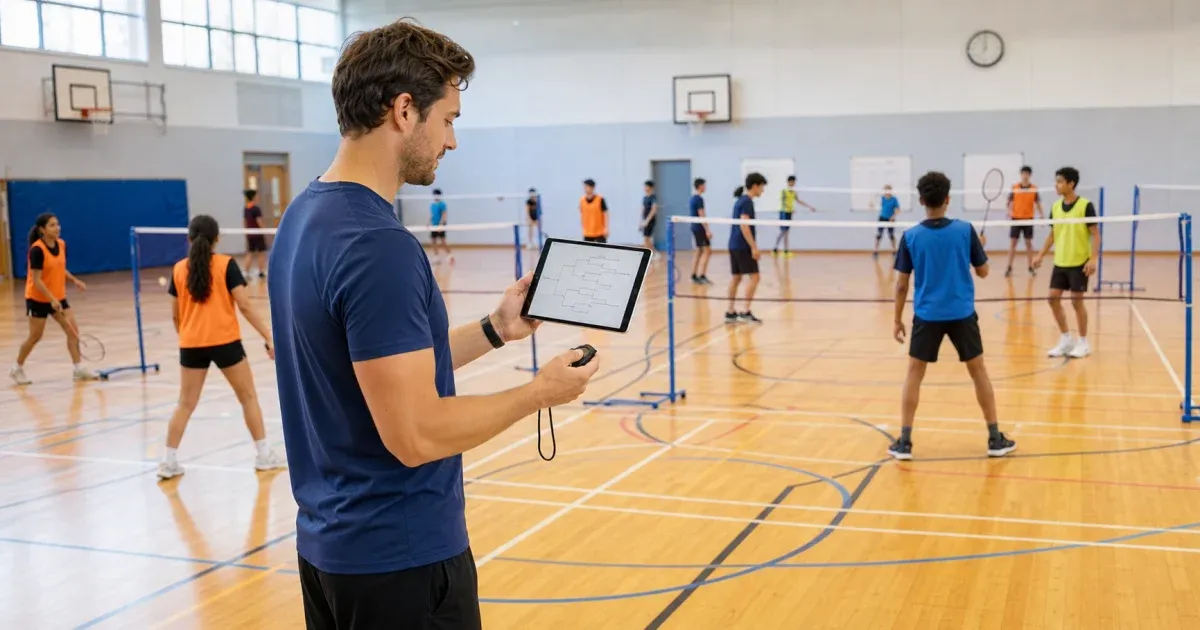
Forty-five minutes on the timetable is never forty-five minutes of actual play. Students need to change, the class needs settling and splitting into teams, and everyone needs time to pack away before the bell. A tournament planned around the lesson length instead of the real playing window is the one that's still going when the next class is waiting at the door.
The short answer
Work out your actual playing minutes first, not the lesson length, then pick a format around the number of courts or pitches you actually have running at once, not just the number of teams. One court means a small elimination bracket. Several courts running in parallel means a small round-robin can fit in the same window and give every student more games.
Start with the real playing window
A 45-minute period rarely gives you 45 minutes of matches. A realistic budget looks like:
- 5 minutes to settle the class and explain the format
- 5 minutes to split into teams and get to courts or pitches
- 30 minutes of actual playing time
- 5 minutes to finish up, tidy equipment, and get students changed
That 30-minute window is what your tournament has to fit inside, and it's the number to plan around, not the 45 on the timetable.
If you want to check the numbers before committing to a format, the free tournament duration calculator compares round-robin, single-elimination, double-elimination, and group-plus-knockout schedules using your team count, match length, breaks, and available courts. It shows how many matches and rounds each option creates, and when the tournament is likely to finish.
Match the format to your courts, not just your teams
The mistake that eats a lesson is choosing a format based on team count alone and ignoring how many matches can actually run at the same time.
One court or pitch: use a small elimination bracket
With everyone waiting on a single playing area, matches run one after another, so the format that produces a winner with the fewest matches wins the time budget. A single-elimination bracket needs N − 1 matches for N teams: an 8-team bracket needs 7 matches, a 4-team bracket needs 3.
At 3 minutes a match, an 8-team bracket takes about 21 minutes, comfortably inside a 30-minute window with time left for a final that runs a little longer. A 4-team bracket takes about 9 minutes, which leaves room to run it twice or add a short round-robin group stage first.
Several courts: a small round-robin fits too
If your class has three or four courts or pitches going at once, badminton courts, mini-goals, table tennis tables, the maths changes, because matches on different courts happen simultaneously. What matters now is the number of rounds, not the number of matches.
A round-robin with an even number of teams needs N − 1 rounds. Six teams split across three courts need 5 rounds, and each round is one match per court running at the same time. At 4 minutes a round, that's about 20 minutes for every team to play every other team once, all 24 students getting 5 games each rather than the smaller number a bracket would guarantee most of them.
That's also exactly the trade-off Fixture.cc's PE teacher tournament generator is built around: a 6-team round-robin runs to 15 matches in total, which suits a longer double lesson or sports afternoon where matches queue on one or two courts; for a single 45-minute lesson with limited courts, a 4-team bracket is the better fit precisely because it doesn't depend on parallel courts to stay fast.
A worked example
A class of 24 students, three mini-football goals set up, 30 minutes of real playing time.
Split into six teams of four and run a round-robin: 5 rounds, three matches per round across the three goals, roughly 20 minutes of play. Every student gets 5 games, and the standings table is the lesson's result, no single bad start ends anyone's afternoon early.
Same class, but only one goal available: six teams in a round-robin would need 15 sequential matches, close to an hour on its own. Switch to a 4-team bracket instead (splitting the class into four larger teams of six), 3 matches, about 9-12 minutes, and use the time saved for a rematch, a mixed-team consolation game, or simply more warm-up.
Setting it up so the lesson isn't spent on admin
The fastest way to lose playing minutes is spending them typing team names into a screen while the class waits. Use the free fixture generator before the lesson, not during it: teams, format, and courts sorted out at your desk means the class walks in and starts playing.
During the lesson, enter scores from a phone as each match finishes rather than saving it all for the end. The public page updates as soon as a result is entered, so a tablet or a corner of a screen can show the live bracket or table without you stopping to write it up separately, and there's nothing to reconcile from memory once the bell goes.
Frequently asked questions
How many teams work best for a 45-minute lesson?
It depends on your courts, not just the class size. With one playing area, keep it to a 4-team bracket so the whole thing fits in around 10 minutes and leaves room for a rematch. With three or four courts running at once, a 6-team round-robin fits comfortably and gives everyone more games.
Should I use a bracket or a round-robin for a single lesson?
Use a bracket when you only have one court or pitch, since it needs the fewest matches to reach a winner. Use a round-robin when you have several courts running in parallel, since every round happens at once rather than one match at a time.
How do I avoid running out of time mid-tournament?
Budget your real playing minutes first, lesson length minus settling in, splitting into teams, and packing away, then pick a team count and format that fits inside that smaller number, not the full timetable slot.
Can I set the tournament up before the lesson starts?
Yes. Creating the competition, naming teams, and generating the schedule takes a couple of minutes and doesn't need to happen in front of the class. Do it beforehand so the lesson starts with play, not setup.
Set your teams and format up before the next lesson with the free PE teacher tournament generator, and the only thing left to do when the bell rings is start the first match.
Our editorial process
How we research and review our content
Our research process depends on the subject. We select the sources that can answer the article's actual question, cross-check important claims, and distinguish documented facts from editorial judgement.
- Practical context and direct experience
- We draw on our team's experience of sports, equipment, and organising competitions when it is relevant. Direct use informs our judgement only where it actually occurred; we do not present research as hands-on testing.
- Primary and authoritative sources
- Depending on the topic, we consult governing-body rules, official guidance, manufacturer specifications and manuals, standards, technical documentation, and other first-party sources.
- Independent and public evidence
- For comparisons and recommendations, we may examine specialist reviews, public customer feedback, retailer information, ratings, and recurring real-world issues. We cross-check patterns and never treat one comment or score as proof.
- Editorial review and updates
- We compare the available evidence with the reader's likely needs, explain uncertainty and trade-offs, verify important claims, and update content when rules, products, features, or source information change.
Share this article
Send this guide to someone who might find it useful.

About the author
Fixture.cc editorial team
The Fixture.cc editorial team is a global group of sports enthusiasts creating practical, trustworthy guides for sports fans, competition organisers, coaches, and teachers.
View editorial profileKeep reading
Related articles
How to Embed a Live League Table on Your Website or Facebook Group
Add a live, self-updating league table to your club website with one embed code, and the right way to share it on Facebook, where iframes don't work.
How to Open Online Registration for Your League or Tournament
Set up an online registration form for your league or tournament so teams sign up themselves, get automatic confirmation, and land straight in your fixtures.
How to Display Live Scores on a TV or Projector at Your Venue
Turn any TV, monitor or projector into a live, auto-updating scoreboard for your tournament or league, with no extra hardware or app to install.