Round Robin with an Odd Number of Teams: How Byes Work
With an odd number of teams, one side sits out each round. Here's how byes are scheduled fairly, and how Fixture.cc handles them automatically.
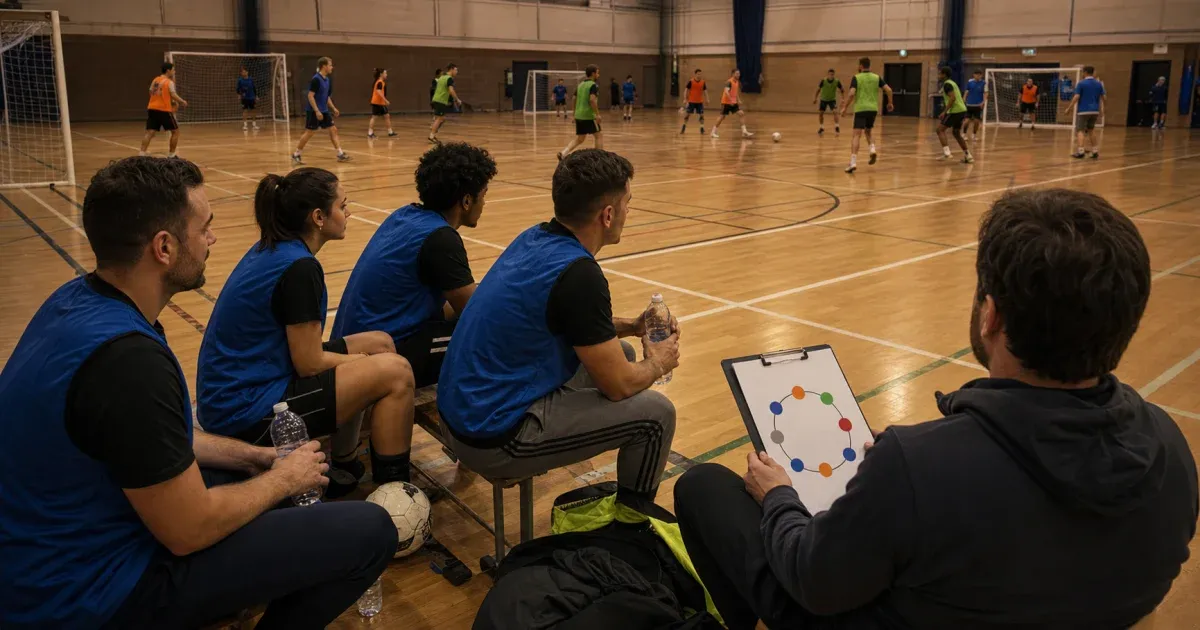
Seven teams have signed up for your league. Everyone else plays in pairs, so with an odd number, someone has to sit out every round. The question that actually causes arguments isn't whether that's necessary, it's whose turn it is, and whether it happens to the same team twice before everyone else has had a rest.
That rest round is called a bye. It isn't a match, a win, or a loss. It's a scheduled week off, and in a fair round-robin, every team gets exactly one before any team gets a second.
If you are deciding how to handle empty positions in a knockout or Swiss draw instead, start with our broader guide to how tournament byes work.
If the odd number was caused by a team leaving after registration or after play began, follow the separate process for handling a team withdrawal before rebuilding the rotation.
The short answer
With an odd number of teams, add one "phantom" opponent to the field. Whoever is paired against the phantom in a given round has a bye that round instead of a match. Rotate the phantom through the schedule the same way you rotate every real opponent, and each team ends up sitting out exactly once over the course of the league.
That has two consequences worth knowing before you build a schedule by hand:
- You need one more round than you'd expect. An even number of teams needs N − 1 rounds. An odd number needs N rounds, because one round is entirely absorbed by giving everyone their bye.
- The number of matches doesn't change. The formula is still N × (N − 1) ÷ 2 total matches. Seven teams still play 21 matches; they're just spread across seven rounds of three matches each instead of six rounds of three-and-a-bit.
Where a hand-built bye schedule goes wrong
Doing this on paper or in a spreadsheet is straightforward for the first pass and then quietly breaks the second time you touch it.
- The bye gets assigned by whoever's convenient, not by rotation. Pick byes ad hoc, round by round, and it's easy to reach round six with two teams who still haven't had a rest and one who's had two.
- A postponed match reshuffles everything. Move one game to a later date and it's tempting to just find "whoever's free" to fill the gap, which quietly breaks the one-bye-each pattern for the rest of the season.
- Nobody notices until someone complains. A team that's had its bye in week two and week nine will spot it. Finding out after eight rounds have already been played leaves you with no clean way to fix it without reopening a schedule people have already built plans around.
The fix isn't a better spreadsheet trick, it's using the same rotation for the bye that you use for every real opponent, so it's simply part of the pairing logic rather than a decision made separately each week.
How the rotation actually works
The standard way to build a round-robin by hand is the circle method: keep one team fixed, arrange the rest around it, and rotate everyone but the fixed team by one position each round. Every rotation produces a fresh set of pairings, and after N − 1 rotations every team has faced every other team exactly once.
With an odd number of teams, add the phantom opponent so the field becomes even, then run the exact same rotation. Whichever real team lands opposite the phantom in a given round has the bye. Because the phantom rotates through the field on the same schedule as everyone else, it reaches every position exactly once, which is exactly what guarantees every team gets exactly one bye by the time the rounds run out.
A worked example: seven teams
Take a five-a-side league with Ravens, Falcons, Hawks, Eagles, Kites, Owls and Wrens. Run the rotation and this is the schedule it produces:
| Round | Matches | Bye |
|---|---|---|
| 1 | Falcons v Wrens, Hawks v Owls, Eagles v Kites | Ravens |
| 2 | Ravens v Wrens, Falcons v Kites, Hawks v Eagles | Owls |
| 3 | Ravens v Owls, Wrens v Kites, Falcons v Hawks | Eagles |
| 4 | Ravens v Kites, Owls v Eagles, Wrens v Hawks | Falcons |
| 5 | Ravens v Eagles, Kites v Hawks, Owls v Falcons | Wrens |
| 6 | Ravens v Hawks, Eagles v Falcons, Owls v Wrens | Kites |
| 7 | Ravens v Falcons, Eagles v Wrens, Kites v Owls | Hawks |
Seven rounds, three matches each, 21 matches in total, and every one of the seven teams appears in the bye column exactly once. No team rests twice, and none is left waiting until the final round to get its turn.
How Fixture.cc handles this automatically
This is exactly what happens when you generate a league on Fixture.cc: enter your team names, and if the count is odd, the round-robin generator adds the bye and rotates it using the same method as the worked example above. There's no separate bye list to maintain and no manual check for who's already sat out. A bye round simply produces one fewer fixture that week; nothing is recorded against either the resting team or the standings, because a bye isn't a match.
It works the same way whether the league is scoring goals, points, or something else entirely, so a five-a-side football league, an esports ladder using best-of-three series, or a league running custom points for a win instead of the usual three all get the same fair rotation. If you're running a double round-robin, the bye repeats in the reverse-fixtures leg too, so an odd-numbered field still ends up with everyone resting the same number of times across the whole season, not just the first half of it.
If you're scheduling on fixed weekly dates rather than leaving dates open, the league schedule generator applies the same rotation, it just also attaches a date to each round, including the ones where your team's turn happens to be the week it rests.
What a bye doesn't do
A bye round doesn't book or release your venue for you. If you've hired a pitch, court or hall for every week of the season, a bye round is still a week where one team simply has no fixture, not necessarily a week where nobody plays at all, since the other teams are still paired up and playing. You'll still need to plan facilities around the real matches each round produces, not around the schedule as a whole.
A bye also isn't a result. It shouldn't be entered as a win, and it shouldn't be scored. If your competition's rules award anything for a bye week, that's a policy decision your league needs to publish before the season starts, not something the schedule itself decides.
Frequently asked questions
Does a bye count as a win or a loss?
No. A bye is a scheduled rest round, not a match. Nothing is recorded against either the team's results or the standings unless your league has published its own separate rule for handling byes.
How many rounds does a round-robin need with an odd number of teams?
N rounds for N teams, one more than the N − 1 rounds an even-numbered field of the same size would need. The extra round is what allows every team to get its single bye.
Can two teams have a bye in the same round?
No. Only one team can be paired against the phantom opponent in any given round, so exactly one team rests per round, never more.
Does an odd number of teams change how many matches are played?
No. The total is still N × (N − 1) ÷ 2 matches regardless of whether N is odd or even. An odd team count spreads the same number of matches across one additional round rather than adding or removing any fixtures.
What happens to byes in a double round-robin with an odd number of teams?
The bye repeats in the reverse-fixtures leg the same way every match does, so the rotation covers the whole season and each team ends up resting the same number of times overall, not just once at the start.
Enter your teams into the free round-robin generator and, if your list comes to an odd number, the bye rotation is handled the moment the fixtures are created, no manual list to keep track of, and no team wondering why they're the only one who's rested twice.
Our editorial process
How we research and review our content
Our research process depends on the subject. We select the sources that can answer the article's actual question, cross-check important claims, and distinguish documented facts from editorial judgement.
- Practical context and direct experience
- We draw on our team's experience of sports, equipment, and organising competitions when it is relevant. Direct use informs our judgement only where it actually occurred; we do not present research as hands-on testing.
- Primary and authoritative sources
- Depending on the topic, we consult governing-body rules, official guidance, manufacturer specifications and manuals, standards, technical documentation, and other first-party sources.
- Independent and public evidence
- For comparisons and recommendations, we may examine specialist reviews, public customer feedback, retailer information, ratings, and recurring real-world issues. We cross-check patterns and never treat one comment or score as proof.
- Editorial review and updates
- We compare the available evidence with the reader's likely needs, explain uncertainty and trade-offs, verify important claims, and update content when rules, products, features, or source information change.
Share this article
Send this guide to someone who might find it useful.

About the author
Fixture.cc editorial team
The Fixture.cc editorial team is a global group of sports enthusiasts creating practical, trustworthy guides for sports fans, competition organisers, coaches, and teachers.
View editorial profileKeep reading
Related articles
What Is a Bye in Sports? Rules, Examples and Calculation
Learn what a bye means in knockout, round-robin and Swiss tournaments, how many byes a bracket needs, and how to award them fairly.
Best of 3 vs Best of 5: Which Esports Series Format Should You Use?
Bo1, Bo3 or Bo5? How each esports series format changes match count and event length, and how to pick the right one for your bracket or league.
How to Embed a Live League Table on Your Website or Facebook Group
Add a live, self-updating league table to your club website with one embed code, and the right way to share it on Facebook, where iframes don't work.