Portable vs In-Ground Basketball Hoops: Which Should You Buy in 2026?
Portable or in-ground basketball hoop? Compare stability, rebound, installation and cost, then see which hoop actually suits your driveway.
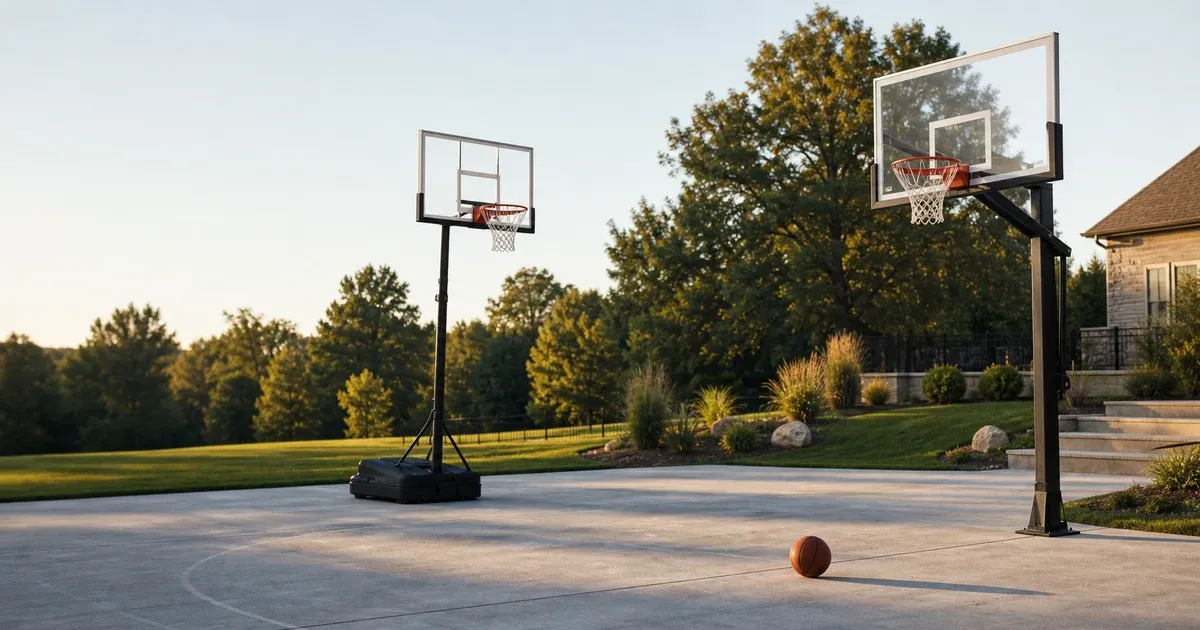
Most people pick a basketball hoop by price, then discover a year later why the backboard rattles after every rebound, or why moving house means leaving a concrete anchor behind for the new owners.
The real question isn't which type is "better." It's whether the court needs to stay flexible or is permanent enough to justify digging. Rent the property, share a driveway, or aren't sure you'll still be there in three years? A portable hoop removes that risk. Own the place, have picked the spot, and want a backboard that barely moves after a hard shot? A proper footing earns its cost.
For most driveways, the Silverback SB60 In-Ground Basketball Hoop is the easiest in-ground recommendation: real tempered glass and a concrete anchor at a price well below the premium brands. If the hoop has to stay movable, start with the Spalding Momentous EZ Assembly 54-Inch Basketball Hoop instead.
The 5 basketball hoops worth considering
- Lifetime 54-Inch Power Lift Portable Basketball Hoop: the cheapest sensible entry point for a family that just wants an adjustable hoop up this weekend.
- Spalding Momentous EZ Assembly 54-Inch Basketball Hoop: a clearer acrylic board and quicker assembly for families who play several times a week.
- Spalding The Beast 60-Inch Glass Portable Basketball Hoop: as close as a portable system gets to in-ground rebound.
- Silverback SB60 In-Ground Basketball Hoop: tempered glass and a concrete anchor without premium pricing.
- Goalrilla FT72 In-Ground Basketball Hoop: for courts used often enough that backboard shake actually matters.
What actually changes between portable and in-ground
Stability and backboard response
An in-ground pole sends force straight through a concrete foundation. A well-installed system barely moves when the ball hits the rim or board, which matters more than it sounds during a hard bank shot, a long rebound, or a rebounding drill where the board needs to settle before the next shot goes up.
A portable hoop stands on a plastic base filled with sand or water. Even a heavy, well-built one introduces more movement than concrete, and the gap widens as players get stronger and start shooting from farther out.
Backboard material matters just as much as the base. Tempered glass gives the most familiar, gym-style rebound but needs a rigid frame to support it. Acrylic is a genuine step up from polycarbonate without glass pricing. Polycarbonate prioritises durability over rebound quality, which is fine for an eight-year-old's first hoop and less convincing for a sixteen-year-old practising jump shots. A big board on a shaky structure often feels worse than a smaller one mounted properly, and the ball itself matters too. Our guide to the best basketballs for indoor and outdoor play explains why a premium indoor ball wears out fast on a driveway.
Installation, footing and what happens when you move
A portable hoop skips the concrete, but a 60-inch glass board still needs two adults, a few hours and a level, unobstructed spot to assemble and fill. Budget for delivery of an oversized box, sand or water for the base, and pole padding if it isn't included.
An in-ground hoop adds utility checks, excavation, concrete, anchor levelling and curing time before anyone shoots a ball. A professional installer is worth the money once you're dealing with a 60- or 72-inch glass board, a sloped site, or local permit rules. Get the full installed price before comparing it against a portable system's shelf price.
The upside worth knowing: anchor-mounted systems like the Silverback SB60 and Goalrilla FT72 bolt onto the concrete plate rather than being embedded in it, so the hoop itself can be unbolted and reinstalled on a new anchor if you move. The original concrete stays behind, and moving a steel pole and glass board is still a job for professionals, but the hoop isn't automatically stranded.
Space, overhang and the neighbours
Overhang is the gap between the pole and the backboard, and it decides how far back the pole sits and how much room players have underneath the rim. It ranges from an 18-inch offset on the Spalding Momentous to four feet on the Goalrilla FT72, and it has to be measured before you order, not after. Mark the rim position, baseline, pole location and any garage door or vehicle route first, then work backwards to where the pole actually goes.
Permanent installations can run into planning rules, homeowners' association restrictions or utility-clearance requirements, so confirm the location is allowed before any concrete gets poured. Portable hoops dodge that but bring their own friction: balls in next door's garden, a base parked too close to the driveway, or a hoop stored somewhere it blocks shared access.
1. Lifetime 54-Inch Power Lift Portable Basketball Hoop: the affordable family option
This is the hoop for a family that wants something adjustable in the driveway without turning it into a project. The polycarbonate board sits on a 3.5-inch, three-piece steel pole, and the Power Lift mechanism moves the rim anywhere between 7.5 and 10 feet, so the same hoop works for a nine-year-old and a visiting adult.
Don't expect glass-like rebound. Polycarbonate is built to survive stray shots and rough handling, not to return the ball crisply, and the 35-gallon base moves more than you'd want if someone starts shooting hard from the three-point line. Lifetime backs it with a five-year limited warranty, which is reasonable for equipment that will mostly see HORSE games and casual practice rather than serious training.
Choose it if the hoop is mainly for children and casual family use, the budget doesn't stretch to acrylic or glass, and you want something workable within a weekend.
2. Spalding Momentous EZ Assembly 54-Inch Basketball Hoop: best mid-range portable hoop
The Momentous exists for families who've outgrown a basic polycarbonate hoop but don't want to commit to concrete. Its clear acrylic board gives a noticeably crisper look and rebound than polycarbonate, and the 18-inch offset leaves more room under the rim than most portable designs of this size.
Spalding built the system around faster assembly, and it genuinely goes together quicker than a typical large portable hoop, though "30 minutes" assumes two people and no interruptions. The 2.75-inch pole and 36-gallon base are still a portable structure, so don't expect it to eliminate shake the way a concrete anchor would.
Choose it if you play several times a week rather than occasionally, acrylic is the rebound-to-price balance you want, and easier setup has real value to you.
3. Spalding The Beast 60-Inch Glass Portable Basketball Hoop: best premium portable hoop
The Beast is what you buy when a concrete anchor isn't an option but a smaller composite board won't cut it either. The 60-inch tempered-glass board and heavy steel frame give a rebound that's genuinely close to a gym backboard, and the four-wheel Power Move base rolls the system without tipping it forward the way a basic two-wheel base does.
That performance comes with real bulk: a 55-gallon base and a 5-inch square pole that make this a serious piece of equipment, not something one person rolls casually around the garden. Spalding also sells The Beast in 54-, 60- and 72-inch, glass and acrylic configurations, so check the exact listing rather than assuming every "Beast" plays the same.
If a concrete anchor genuinely is possible, an in-ground hoop at this price point will usually out-perform it. Choose The Beast when permanence isn't an option and you still want the closest thing to in-ground rebound.
4. Silverback SB60 In-Ground Basketball Hoop: best-value in-ground hoop
The SB60 is the hoop for homeowners who want a real concrete-anchored system without paying premium-brand prices. The 60-by-33-inch board is 5/16-inch tempered glass on a 4-by-4-inch powder-coated steel pole, and the crank adjusts the rim from 7.5 to 10 feet. The anchor kit, pole pad, backboard pad and breakaway rim all come included, which matters because those accessories add up fast when bought separately.
It carries a five-year limited warranty rather than the lifetime coverage on pricier Goalrilla systems, and the board and pole are lighter than a regulation 72-inch setup. For a normal driveway, that's a sensible trade, not a shortfall. Because it bolts to the anchor rather than being embedded in it, the SB60 can also be unbolted and reinstalled if you move.
Choose it if you want real tempered glass at an accessible price and the driveway suits a 60-inch board rather than a full 72-inch one.
5. Goalrilla FT72 In-Ground Basketball Hoop: for serious, frequent training
The FT72 is built for players who will actually notice backboard shake, which usually means a court used several times a week rather than a few times a month. The regulation 72-by-42-inch board is 3/8-inch tempered glass on a 6-by-6-inch pole, with a four-foot overhang that gives real room to drive to the basket.
Its stability comes from what Goalrilla calls Three-Point Technology: a one-piece pole, dual extension arms and a triple-joint connection that mount the board internally instead of bolting it straight to the pole face. In practice that means less flex feeding back into the board after a dunk or a hard rebound. It's backed by a limited lifetime warranty and includes the anchor kit, breakaway rim and pole pad.
None of that matters if the court is too narrow for a regulation-width board and four-foot overhang. Choose the FT72 when the space and the level of play both justify it; choose the SB60 instead when a smaller board and lighter footing make more sense for the driveway you actually have.
So, which hoop should you buy?
If you're not sure the hoop will stay at this address, or drilling isn't an option, start with the Spalding Momentous for regular family use, or the Lifetime Power Lift if budget matters more than rebound. Step up to The Beast only if you need glass-level performance without a permanent anchor.
If you own the property and have settled on where the hoop goes, the Silverback SB60 is the sensible default: real glass, a proper anchor, and a price that doesn't require justifying to anyone. Move up to the Goalrilla FT72 once the court gets frequent, serious use and backboard shake is something players actually complain about.
A few mistakes worth avoiding
Buying by backboard size alone
Board width is one spec among several. Pole thickness, frame, anchor and base determine how the board actually behaves when the ball hits it, and a bigger board on a weak structure often plays worse than a smaller one mounted properly.
Assuming "portable" still means easy to move once it's filled
A sand-filled premium base can weigh hundreds of pounds. Decide on the hoop's normal spot before you fill the base, not after you've tried to roll it over a kerb.
Ordering before measuring the overhang
The overhang decides where the pole physically goes. Mark the rim, baseline and pole location on the ground before ordering, not after the box arrives.
Digging before checking what's underground
A premium hoop's footing can be deep and wide. Get utilities marked before excavation, regardless of how confident anyone is about what's down there.
Frequently asked questions
Is an in-ground basketball hoop better than a portable hoop?
Generally yes for stability, rebound consistency and frequent serious play, because a concrete foundation moves far less than a filled portable base. A premium portable hoop can still outperform a cheap in-ground one, so compare the actual structure rather than just the category.
Can an in-ground basketball hoop be moved later?
Anchor-mounted systems like the Silverback SB60 and Goalrilla FT72 can be unbolted from the concrete plate and reinstalled on a new anchor elsewhere. It still means professional disassembly, transport and a new footing, and the original concrete stays at the old property.
Is tempered glass worth it on a home hoop?
Worth it if rebound quality matters and the pole and frame are rigid enough to support it properly. For young children and casual family use, acrylic or polycarbonate often gives better value for the money.
What size backboard suits a normal driveway?
A 54-inch board covers most family driveways comfortably. A 60-inch board is the common step up for serious residential play, and a 72-inch regulation board needs a genuinely wide court to make sense. Measure the space before choosing the size.
Do you need permission to install an in-ground basketball hoop?
Possibly, depending on your municipality, property type and any homeowners' association rules. Check planning requirements and utility clearance before any excavation starts.
Organise the games after choosing the hoop
Once the court is ready, the next job is turning players into an organised competition.
Fixture.cc's free basketball fixture generator creates round-robin fixtures, knockout brackets and tournament schedules without a spreadsheet. Define the participants, generate the matchups, and give players, coaches and parents a schedule they can actually follow.
Our editorial process
How we research and review our content
Our research process depends on the subject. We select the sources that can answer the article's actual question, cross-check important claims, and distinguish documented facts from editorial judgement.
- Practical context and direct experience
- We draw on our team's experience of sports, equipment, and organising competitions when it is relevant. Direct use informs our judgement only where it actually occurred; we do not present research as hands-on testing.
- Primary and authoritative sources
- Depending on the topic, we consult governing-body rules, official guidance, manufacturer specifications and manuals, standards, technical documentation, and other first-party sources.
- Independent and public evidence
- For comparisons and recommendations, we may examine specialist reviews, public customer feedback, retailer information, ratings, and recurring real-world issues. We cross-check patterns and never treat one comment or score as proof.
- Editorial review and updates
- We compare the available evidence with the reader's likely needs, explain uncertainty and trade-offs, verify important claims, and update content when rules, products, features, or source information change.
Share this article
Send this guide to someone who might find it useful.

About the author
Fixture.cc editorial team
The Fixture.cc editorial team is a global group of sports enthusiasts creating practical, trustworthy guides for sports fans, competition organisers, coaches, and teachers.
View editorial profileKeep reading
Related articles
Best Cameras for Recording Youth Football Matches in 2026
Five cameras for filming youth football from the sideline, chosen for battery life, wide field of view, stabilization, and standing up to a wet touchline.
5 Best Pickleball Paddles for Every Playing Style
Five current pickleball paddles for control, value, quick handling, power and premium play, with practical advice on choosing the right shape.
5 Best Budget Gaming Monitors Under USD 200 for Esports
Five gaming monitors under USD 200 with refresh rates and response times suited to competitive esports, from compact displays to 1440p options.