5 Best Basketballs for Indoor and Outdoor Play in 2026
Five of the best current basketballs for indoor gyms, outdoor courts and mixed-surface play, compared by cover, feel, durability and intended use.
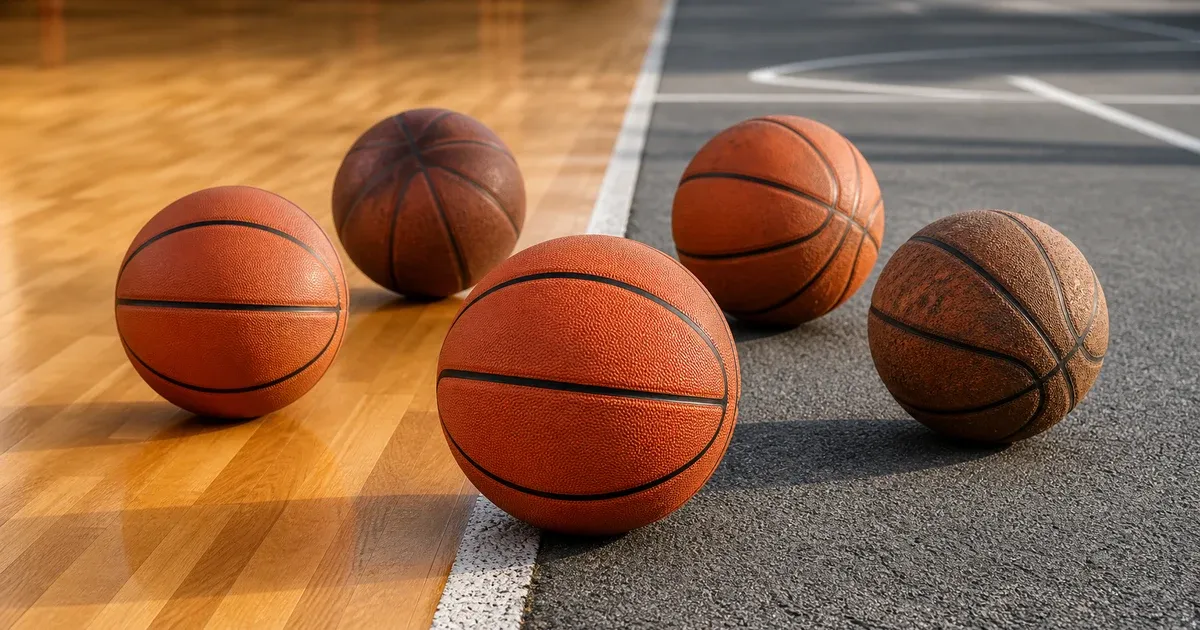
The best basketball is not necessarily the most expensive one or the model used in the highest-profile competition. It is the ball that matches the court where you actually play.
A premium leather basketball can feel excellent after it has been broken in on hardwood, but rough concrete can damage its surface surprisingly quickly. A durable outdoor ball will tolerate asphalt much better, although it may feel firmer and less refined in a gym. Indoor/outdoor balls sit between the two: practical for players who regularly switch surfaces, but rarely as specialised as a dedicated ball.
That is why this guide does not attempt to rank five completely different basketballs from first to fifth. Instead, each selection is the strongest choice for a particular type of player, team or court.
The best basketballs in 2026 at a glance
Wilson Evolution
For most indoor players, school teams and amateur clubs, this composite ball is the safest starting point.
The Wilson Evolution is the most broadly useful indoor choice in this guide. It combines a soft feel, dependable grip and game-ready composite construction without requiring a leather break-in period.
Molten BG5000
Serious indoor players and FIBA-style competitions are where this top-grain genuine-leather ball makes the most sense.
The Molten BG5000 is the specialist option for players and clubs that want the feel and 12-panel design associated with high-level international basketball.
Spalding TF-1000 Legacy
Choose this microfiber composite option if you prefer a structured, game-ready feel indoors.
The Spalding TF-1000 Legacy offers defined channels, moisture management and a firmer response than the Wilson Evolution, making it a strong alternative for organised indoor play.
Wilson NBA Authentic Indoor/Outdoor Basketball
Players who regularly move between gyms and outdoor courts will get the most from this mixed-surface ball and its Pure Feel moisture-management cover.
The Wilson NBA Authentic Indoor/Outdoor Basketball is the practical all-rounder. It sacrifices some specialisation in exchange for the convenience of using one ball across different court surfaces.
Wilson NBA Authentic Outdoor Basketball
For regular play on asphalt, concrete and playground courts, the Tackskin cover makes this the dedicated outdoor choice.
The Wilson NBA Authentic Outdoor Basketball prioritises durability and grip on abrasive surfaces, making it the better choice when most sessions happen outside.
1. Wilson Evolution: best indoor basketball for most players
The Wilson Evolution remains one of the safest recommendations for school teams, amateur clubs, training groups and players who spend most of their time in a gym.
Its composite cover has a soft, slightly cushioned feel that makes the ball comfortable to catch and control. The channels are easy to locate during dribbling and shooting, while the surface provides dependable grip without requiring the lengthy break-in associated with genuine leather.
The Evolution is approved by the National Federation of State High School Associations, commonly known as the NFHS. That approval does not make it the mandatory ball for every school or competition, but it confirms that it meets the relevant high-school game-ball specifications.
The main limitation is straightforward: this is an indoor basketball. Although one session on a clean outdoor court will not instantly destroy it, repeated use on asphalt or concrete will wear down the cover and permanently change the feel.
Choose the Wilson Evolution if:
- You primarily train or compete indoors.
- You want a soft composite ball that feels comfortable immediately.
- Several players will share the ball during practices or matches.
- You want a recognised indoor model without paying for genuine leather.
Avoid it if: the ball will regularly be used on an outdoor court.
2. Molten BG5000: best premium FIBA-style basketball
The Molten BG5000 is the premium choice for players and clubs that want the feel associated with top-level FIBA competition.
Unlike most recreational and school basketballs, the BG5000 uses a top-grain genuine leather cover. Its distinctive 12-panel design also feels noticeably different from the traditional eight-panel construction used by many American basketballs. Players accustomed to Molten balls often appreciate the additional seams as reference points when passing, dribbling and setting their hands for a shot.
A new BG5000 should not be judged entirely by its first session. Genuine leather becomes softer and more responsive through consistent indoor use. During the initial break-in period, the surface may feel firmer or smoother than expected. The final feel is one of the reasons serious players buy it, but reaching that point requires more patience than with a game-ready composite ball.
The BG5000 is also a specialised purchase. It costs more than a typical composite ball and should be protected from concrete, asphalt, moisture and poor storage conditions.
Choose the Molten BG5000 if:
- Your competition uses Molten or FIBA-style basketballs.
- You want a genuine-leather game ball.
- You are willing to break the ball in properly.
- It will be reserved for clean indoor courts.
Avoid it if: you need a casual family ball, an outdoor ball or one basketball for every surface.
3. Spalding TF-1000 Legacy: best game-ready indoor composite alternative
The Spalding TF-1000 Legacy is another strong indoor option, particularly for players who prefer a more structured, game-ball feel than the softer Wilson Evolution.
Its microfiber composite cover is designed to manage moisture and provide useful grip without requiring a genuine-leather break-in period. Spalding also uses pronounced channels and what it calls its Shooter's Seam, making the panel boundaries easy to recognise by touch.
The TF-1000 Legacy is NFHS-approved and is used by a range of high-school and college programmes. Dedicated editions are also associated with organisations such as the NAIA and NJCAA. It is not, however, the official NCAA championship basketball. That distinction belongs to the Wilson NCAA Evo NXT.
The choice between the Evolution and TF-1000 Legacy is largely one of feel. The Evolution tends to appeal to players who want something softer and more cushioned. The TF-1000 Legacy is often preferred by players who like clearer channels, a somewhat firmer response and a ball that feels ready for organised play immediately.
Choose the Spalding TF-1000 Legacy if:
- You want a premium composite indoor ball.
- You prefer defined channels and a structured grip.
- You do not want to break in genuine leather.
- Your school, league or club already uses Spalding balls.
Avoid it if: you regularly play outdoors.
Players preparing specifically for NCAA championship-style conditions should also consider the Wilson NCAA Evo NXT, the official ball used in the NCAA men's and women's basketball championships.
4. Wilson NBA Authentic Indoor/Outdoor Basketball: best basketball for mixed surfaces
The Wilson NBA Authentic Indoor/Outdoor Basketball is the practical choice for players who genuinely divide their time between a gym and an outdoor court.
Its Pure Feel moisture-management cover is designed to provide more grip and a more refined touch than a basic rubber playground ball. Wilson also uses Ever Bounce construction and an inflation-retention lining intended to maintain consistent performance over time.
The important phrase here is mixed surfaces. An indoor/outdoor basketball is useful when the same ball must serve several locations. It is not automatically the longest-lasting option for someone playing on rough asphalt every day, nor will it feel exactly like a premium indoor-only ball on hardwood.
For a family sharing one ball, a school with both indoor and outdoor facilities, or a player who alternates between club training and pickup games, that compromise makes sense. For players who use one surface almost exclusively, a specialised ball remains the better purchase.
Choose the Wilson NBA Authentic Indoor/Outdoor Basketball if:
- You regularly switch between indoor and outdoor courts.
- You only want to maintain and transport one basketball.
- You want a more refined feel than a basic rubber ball.
- Convenience matters more than maximum specialisation.
Avoid it if: nearly all your sessions happen on rough outdoor surfaces. A dedicated outdoor ball will generally be the more sensible choice.
5. Wilson NBA Authentic Outdoor Basketball: best dedicated outdoor basketball
The Wilson NBA Authentic Outdoor Basketball is intended for players whose basketball will spend most of its life on asphalt, concrete, playground courts or other abrasive surfaces.
Its Tackskin cover is designed to maintain useful grip in outdoor conditions, while its pressure-lock construction helps with air retention. The surface feels firmer than the covers found on premium indoor balls, but that is part of the trade-off required for regular outdoor use.
A dedicated outdoor ball is usually the better investment when at least three-quarters of your play happens outside. There is little benefit in buying an expensive indoor model only to grind away its cover, and a mixed-surface ball may be an unnecessary compromise when it rarely enters a gym.
No basketball is immune to outdoor wear. Court texture, dirt, moisture, temperature, storage and inflation all affect how long a ball lasts. Nevertheless, using a model explicitly designed for outdoor courts gives it a much better chance than taking an indoor composite or leather ball onto the same surface.
Choose the Wilson NBA Authentic Outdoor Basketball if:
- You mainly play on asphalt or concrete.
- Durability matters more than a soft indoor feel.
- The ball may be shared at a school, park or public court.
- You want a step above a basic recreational rubber ball.
Avoid it if: you want a premium match-ball feel for indoor competition.
Understand the cover before choosing a ball
The cover material affects grip, feel, durability, break-in time and the surfaces on which the basketball should be used.
Genuine leather
Genuine leather is normally reserved for premium indoor game balls. It can develop an excellent combination of softness and grip after being broken in, but it is expensive and comparatively vulnerable to abrasive outdoor surfaces.
A leather basketball should be used on clean indoor courts and stored in a dry, temperature-stable place. It is unnecessary for most casual players, but it makes sense for teams preparing with the same type of ball used in their competition.
Composite or synthetic covers
Composite covers appear on both indoor-only and indoor/outdoor basketballs. The word “composite” does not by itself tell you where a ball should be used.
Some composite materials are engineered for soft indoor feel and moisture control. Others are formulated to tolerate more abrasion and changing conditions. Always follow the manufacturer's stated surface designation rather than assuming every synthetic ball can safely be used outside.
Rubber
Rubber basketballs are generally inexpensive, durable and well suited to playgrounds, schools and rough outdoor courts. Their main disadvantage is feel: they are usually firmer, livelier and less comfortable in the hands than premium composite or leather balls.
Rubber remains a sensible choice for young children, public equipment cupboards and situations where the ball will receive heavy use with limited maintenance.
Pick the correct basketball size
A high-quality ball in the wrong size is still the wrong ball.
FIBA's official equipment specifications define three principal sizes.
Size 7
Size 7 basketballs have an official circumference of 750-770 mm and are used for men's competition. Retailers commonly describe them as approximately 29.5 inches.
Size 6
Size 6 basketballs have an official circumference of 715-730 mm and are used for women's competition. Retailers commonly describe them as approximately 28.5 inches.
Size 5
Size 5 basketballs have an official circumference of 685-700 mm and are used for mini basketball. Retailers commonly describe them as approximately 27.5 inches.
FIBA coaching guidance commonly associates size 7 with men and boys aged approximately 14 and older, size 6 with women and players around ages 12 to 13, and size 5 with players around ages 9 to 11. These are useful guidelines, not substitutes for the rules of a particular league.
For organised basketball, check the competition regulations before ordering balls for an entire team. Do not move a young player to a larger ball solely because they are tall or physically strong. A suitable size makes it easier to practise controlled passing, dribbling and shooting without compensating for excessive weight or circumference.
Younger children may benefit from size 3, size 4 or lightweight size 5 balls, depending on the programme and basket height.
Common mistakes when buying a basketball
Buying an expensive indoor ball for outdoor use
Premium pricing does not make a basketball more durable on concrete. Genuine leather and soft indoor composite covers can lose their intended texture quickly when repeatedly exposed to abrasive courts.
Assuming every composite ball is indoor/outdoor
The Wilson Evolution and Spalding TF-1000 Legacy both use composite covers, but both are intended for indoor play. The manufacturer's surface designation matters more than the general material category.
Choosing by brand rather than by competition
A player preparing for a league that uses Molten balls may benefit more from practising with a Molten panel design than from buying a similarly priced Wilson or Spalding model. Match the training ball to the competition ball when consistency matters.
Using the wrong size for youth players
An oversized ball can encourage players to push the ball from the chest or shoulder because they cannot comfortably control it. Use the size prescribed for the age group and competition.
Overinflating the ball
A harder ball is not necessarily a better-performing ball. Excess pressure can make the bounce difficult to control and the surface uncomfortable to handle. Follow the pressure recommendation printed on the ball or supplied by its manufacturer, and check it with a pressure gauge rather than judging only by touch.
Judging a leather ball immediately
Composite balls are generally designed to feel usable out of the box. Genuine leather balls are different. Their grip and softness develop through indoor play, so the first session is not always representative of the long-term feel.
Which basketball should you buy?
For most indoor players, the Wilson Evolution is the easiest recommendation. It is comfortable, familiar and suitable for serious training without the cost or maintenance of genuine leather.
Choose the Molten BG5000 when you specifically want a premium FIBA-style leather ball and have a clean indoor court on which to use it.
Choose the Spalding TF-1000 Legacy when you want an indoor composite game ball with pronounced seams, moisture management and a more structured feel.
Choose the Wilson NBA Authentic Indoor/Outdoor Basketball when the same basketball must regularly move between the gym and the park.
Choose the Wilson NBA Authentic Outdoor Basketball when asphalt and concrete are the ball's normal environment.
The most expensive ball on this list is not automatically the best purchase. A dedicated outdoor ball used on concrete is a better investment than a leather competition ball destroyed by the wrong surface, just as a premium indoor ball makes little sense for a player who only visits the gym twice a year.
Frequently asked questions
What is the best basketball for both indoor and outdoor play?
The Wilson NBA Authentic Indoor/Outdoor Basketball is the most practical choice from this list when one ball must regularly be used on both hardwood and outdoor courts. It offers a more refined feel than a basic rubber ball while using construction intended to tolerate mixed-surface use.
A mixed-surface ball is still a compromise. Players who spend almost all their time indoors or outdoors will usually get better feel or durability from a ball designed specifically for that surface.
Can you use a Wilson Evolution outside?
You can take a Wilson Evolution outdoors occasionally, but it is not designed for repeated use on asphalt or concrete. Rough surfaces will gradually wear down its soft composite cover, reduce the grip and change the way the ball feels indoors.
For regular outdoor sessions, use a dedicated outdoor or indoor/outdoor basketball instead.
What basketball size should an adult use?
Most adult men's competitions use a size 7 basketball, while adult women's competitions generally use a size 6. Recreational players can also choose the size that matches the rules of the group or league in which they play.
When buying for an organised team, always confirm the competition regulations rather than relying only on age or gender-based retail descriptions.
What is the best basketball for concrete or asphalt?
A dedicated outdoor model such as the Wilson NBA Authentic Outdoor Basketball is a better choice for concrete and asphalt than a premium indoor ball. Outdoor basketballs use covers and internal construction intended to tolerate more abrasion, dirt and changing conditions.
Even outdoor balls wear down eventually, especially on very rough courts. Cleaning the ball, maintaining the correct pressure and storing it away from moisture and extreme temperatures can help extend its usable life.
Are leather basketballs better than composite basketballs?
Leather is not automatically better. A broken-in genuine-leather ball can provide an excellent indoor competition feel, but it costs more, requires careful use and should not be taken outdoors.
Composite basketballs are more practical for most players. Premium indoor composite balls provide good grip immediately, while specialised indoor/outdoor composites offer greater versatility and resistance to surface wear.
How much should a basketball be inflated?
Use the pressure range printed on the basketball or provided by its manufacturer. Different models can have different recommendations, so there is no advantage in inflating every ball to the same pressure.
A pressure gauge is more reliable than squeezing the ball by hand. Overinflation can make the bounce difficult to control, while underinflation can make passing and dribbling feel slow and inconsistent.
How long does a basketball last?
There is no fixed lifespan. An indoor ball used only on clean hardwood and stored properly can remain playable for years, while a ball used daily on rough concrete may show significant wear much sooner.
Surface, frequency of use, inflation, moisture, temperature and storage all matter. Replace the ball when the cover has lost useful grip, the shape has become uneven, the bladder no longer retains pressure or the bounce becomes inconsistent.
Do genuine-leather basketballs need to be broken in?
Yes. A new genuine-leather basketball often feels firmer or smoother than it will after regular indoor use. Handling, passing, dribbling and shooting gradually soften the surface and help it develop its intended grip.
Avoid artificial shortcuts involving water, oils, chemicals or abrasive treatments. Normal indoor play is the safest way to break in a leather ball.
Organise the games after choosing the equipment
Once your team has the right basketball, the next job is turning a group of players into an organised competition.
Fixture.cc's free basketball fixture generator can create round-robin fixtures, knockout brackets and tournament schedules without requiring a spreadsheet. You can define the participants, generate the matchups and give everyone a schedule they can follow.
Good equipment cannot repair a badly organised competition, and a perfect schedule cannot stop an indoor basketball from wearing out on concrete. Choose the ball for the court, choose the size for the players, and make both decisions before the first game begins.
Our editorial process
How we research and review our content
Our research process depends on the subject. We select the sources that can answer the article's actual question, cross-check important claims, and distinguish documented facts from editorial judgement.
- Practical context and direct experience
- We draw on our team's experience of sports, equipment, and organising competitions when it is relevant. Direct use informs our judgement only where it actually occurred; we do not present research as hands-on testing.
- Primary and authoritative sources
- Depending on the topic, we consult governing-body rules, official guidance, manufacturer specifications and manuals, standards, technical documentation, and other first-party sources.
- Independent and public evidence
- For comparisons and recommendations, we may examine specialist reviews, public customer feedback, retailer information, ratings, and recurring real-world issues. We cross-check patterns and never treat one comment or score as proof.
- Editorial review and updates
- We compare the available evidence with the reader's likely needs, explain uncertainty and trade-offs, verify important claims, and update content when rules, products, features, or source information change.
Share this article
Send this guide to someone who might find it useful.

About the author
Fixture.cc editorial team
The Fixture.cc editorial team is a global group of sports enthusiasts creating practical, trustworthy guides for sports fans, competition organisers, coaches, and teachers.
View editorial profileKeep reading
Related articles
Best Cameras for Recording Youth Football Matches in 2026
Five cameras for filming youth football from the sideline, chosen for battery life, wide field of view, stabilization, and standing up to a wet touchline.
5 Best Pickleball Paddles for Every Playing Style
Five current pickleball paddles for control, value, quick handling, power and premium play, with practical advice on choosing the right shape.

5 Best Budget Gaming Monitors Under USD 200 for Esports
Five gaming monitors under USD 200 with refresh rates and response times suited to competitive esports, from compact displays to 1440p options.