Best Cameras for Recording Youth Football Matches in 2026
Five cameras for filming youth football from the sideline, chosen for battery life, wide field of view, stabilization, and standing up to a wet touchline.
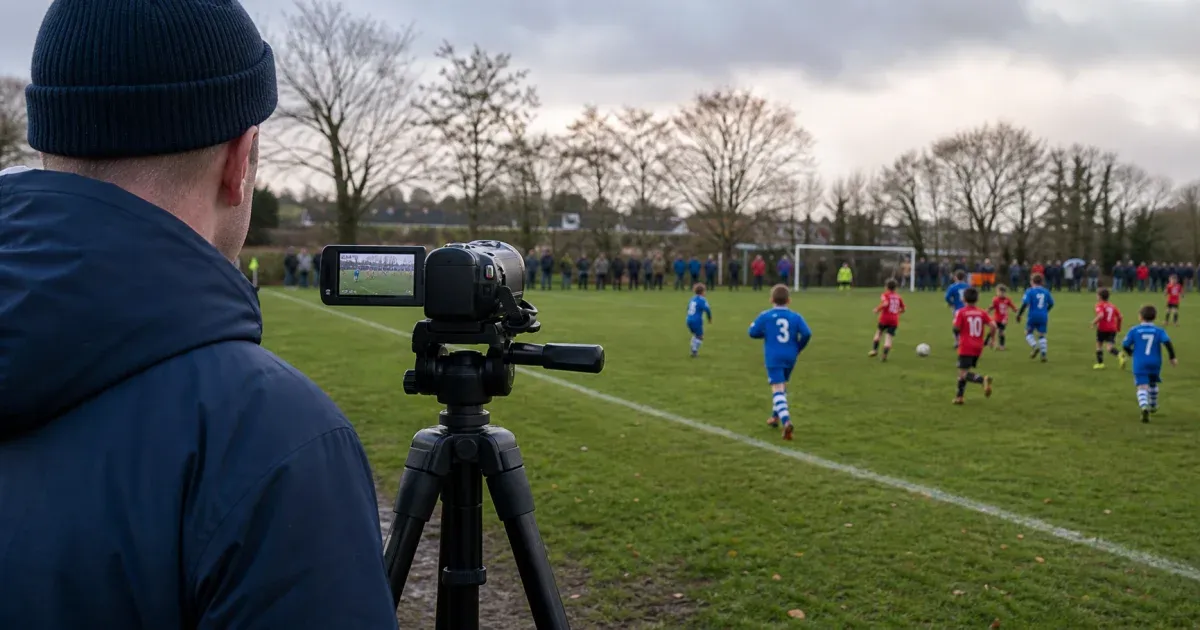
Most parents start filming matches on a phone propped against a water bottle. It works for one half, until the battery drops into the red at 30 minutes, the picture is too far away to see a face, or a gust knocks the whole setup into the mud.
A dedicated camera solves the problems a phone can't: enough battery to cover a full match without swapping devices mid-play, a wide enough view to keep the game in frame without an operator constantly reframing, and, for anyone filming outdoors through a whole season, something that survives being left out in the rain.
For most parents and volunteer coaches filming one team from one sideline, the Sony FDR-AX43A is the sensible starting point. It pairs a proper zoom with steady enough handheld footage that reviewing it with the team afterwards is actually watchable, and its battery comfortably outlasts a youth match. If you'd rather not operate a camera at all, the Veo Cam 3 records the entire pitch on its own from a single fixed position, at a price that makes more sense for a club than for one family.
The best cameras for youth football at a glance
Sony FDR-AX43A
The best balance of zoom, stabilization and full-match battery life for one parent filming from the touchline
Veo Cam 3
Records the whole pitch automatically with no operator, at a price built for a club rather than a family
Panasonic Lumix FZ80D
The longest reach for the money, useful on a full-size pitch when you can't stand close to the far touchline
GoPro HERO13 Black
Built to sit on a tripod through rain and mud without a case, at the cost of battery life for a full match
Pivo Pod
Turns a phone you already own into a mount that follows your own child around the pitch
What actually matters when choosing a match-day camera
Battery life for the length of the match, not the length of a clip
A youth match with two halves, a break and warm-up either side is easily 75 to 90 minutes on the touchline. A camera rated for "hours of battery" in marketing copy often means hours of standby, not hours of continuous recording, and continuous recording at 4K drains a battery much faster than the same camera shooting 1080p.
Check the continuous recording figure specifically, not the general battery rating, and if it falls short of your typical match length, budget for a spare battery or a power bank rather than assuming you'll catch every minute on one charge.
A wide enough field of view to keep the game in frame
From a single fixed spot on the touchline, a narrow lens forces constant panning to keep play in shot, which is exactly what produces shaky, motion-sick footage when you review it later. A wider field of view, or a longer zoom you can back off when play is close, gives you more margin before the ball leaves the frame entirely.
This is also where automated wide-angle cameras have a real advantage: filming the entire pitch from one elevated position removes the panning problem altogether, at the cost of detail on any one player unless you zoom in during editing afterwards.
Stabilization, so the footage is watchable
Handheld footage from a full match, especially if you're also cheering, talking to other parents or holding a bag, moves far more than it feels like it does in the moment. Optical stabilization built into the lens or sensor handles this far better than software stabilization applied after recording, which tends to crop the frame and can smear fast motion.
If you're mounting the camera on a tripod rather than holding it, stabilization matters less for the shot staying steady and more for how smoothly it can pan as you follow play by hand.
Storage and recording length
4K video eats through storage far faster than 1080p, and a card that fills up at half-time means missing the second half entirely. Work out roughly how much footage a full match produces at your chosen resolution, and buy a card with real headroom rather than the exact minimum, since accidentally leaving the last match on the card is a common way to run out mid-game.
Weatherproofing, if you're filming outdoors all season
A camera that's fine on a dry autumn afternoon can be a real problem on a wet January morning. Action cameras and purpose-built sports cameras are usually rated for rain and cold without extra protection. Standard camcorders and bridge cameras generally aren't, and need a rain cover or an umbrella-holding volunteer if the forecast turns.
Price tiers, and what you're actually paying for
Roughly speaking, phone-mount and auto-tracking accessories sit under $150 and turn a phone you already own into something more useful than a hand holding it. Camcorders and bridge cameras with real optical zoom sit in the $400 to $600 range and are the point where footage starts looking genuinely good enough to review technique from. Purpose-built, fully automated sports cameras start well over $1,000 and are really a club or academy purchase rather than something one family buys for one child's Saturday matches, particularly once an ongoing subscription is factored in for cloud storage or advanced analysis.
1. Sony FDR-AX43A: the best all-round choice for one parent on the touchline
The Sony FDR-AX43A is built for exactly the situation most parents are actually in: standing on one sideline, holding the camera or resting it on a tripod, trying to follow play across a full pitch.
Its 20x optical zoom (extending further with digital zoom) means you're not stuck at one fixed distance the way a phone camera is, and Sony's Balanced Optical SteadyShot stabilization keeps handheld footage steady enough to actually watch back with the team afterwards, rather than a blur that makes everyone seasick. Recorded in 4K, there's enough detail to freeze a frame and actually see foot position or body shape, which matters if the footage is going to be used for coaching feedback and not just as a souvenir.
Battery life is where it separates itself from casual alternatives: typical continuous 4K recording runs to roughly 90 to 150 minutes per charge, which covers a full youth match without a battery swap in most cases. It isn't weatherproof, so a wet matchday means keeping it under cover between spells of rain rather than leaving it exposed on a tripod.
For the parent who wants one camera that handles zoom, stabilization and a full match's worth of recording without constant fiddling, this is the one to start with.
2. Veo Cam 3: the best choice when nobody's free to operate a camera
Some matchdays, the person who'd normally film is coaching, refereeing, or just wants to actually watch the game rather than stand behind a viewfinder for 90 minutes. That's the problem the Veo Cam 3 solves.
Mounted on a tall tripod at the halfway line, it records a 180-degree panoramic view of the whole pitch in 4K, and its AI tracking follows the game automatically so nobody needs to pan, zoom or reframe during play. It's rated to handle rain, snow and a wide temperature range, and at under 3 lbs it's genuinely easy to carry between a car and a pitch, home or away.
The trade-off is cost and complexity that only really make sense at club scale. The camera itself is a four-figure purchase, and getting the most from it, automatic highlight clips, tagging, and deeper post-match analysis, typically involves an ongoing subscription on top of that. For one family filming one child's matches, that's a lot of machinery for a job a $500 camcorder can also do, just with someone holding it.
Where it earns its price is a club or academy filming every team, every week, without needing a volunteer free on every single touchline.
3. Panasonic Lumix FZ80D: the longest reach for the least money
Full-size pitches are wide, and if your only vantage point is one touchline, play on the far side can end up as tiny, indistinct figures on anything with a modest zoom.
The Panasonic Lumix FZ80D answers that with a 60x optical zoom, equivalent to a 20-1200mm lens, which is a genuinely enormous range for a camera in its price bracket. Optical image stabilization helps keep that zoom usable handheld rather than shaky and unwatchable at full reach, and it shoots 4K video alongside stills, so the same camera covers both a highlight photo and match footage.
It isn't marketed as a sports camera specifically, and it shows in a few places: there's no weatherproofing to speak of, and battery life on bridge cameras like this generally trails a purpose-built camcorder, so a spare battery is worth having for a full match. It's also a stills-first camera pressed into video duty rather than the other way round, and the menu and ergonomics reflect that.
For the reach it offers at this price, though, it's the obvious pick for anyone regularly filming from a distance the camera on their phone simply can't cover.
4. GoPro HERO13 Black: built for the touchline in bad weather
Some pitches don't have a dugout, a gazebo, or anywhere dry to stand, and that's where the GoPro HERO13 Black makes more sense than a conventional camcorder.
It's waterproof to 33 feet without any additional housing, so rain, mud splashes or a ball landing nearby aren't a reason to pack it away. Mounted on a small tripod, its wide-angle lens (wider still with the optional Ultra Wide Lens Mod) covers a useful chunk of the pitch without constant repositioning, and HyperSmooth stabilization handles handheld panning well if you'd rather follow play by hand than leave it fixed.
The real limitation is battery: roughly 3 hours at 1080p or closer to 1.5 hours at its highest 5.3K setting, which can fall short of a full match at the resolution that actually looks good. A spare battery or a power bank connected during play closes that gap, but it is an extra thing to plan for that a dedicated camcorder doesn't require.
Choose it when the weather, not the footage quality, is the thing most likely to end your filming early.
5. Pivo Pod: the cheapest way to stop missing your own child's moments
Not every parent wants footage of the whole match. Plenty just want to actually see their own child on the ball instead of a wide shot where they're one of twenty-two distant figures.
The Pivo Pod is a motorized stand, not a camera itself: it holds a phone you already own and rotates to keep a chosen player in frame using AI tracking, either following faces and bodies automatically or a target you draw a box around at kickoff. At under $150, it's by far the cheapest entry on this list, and it turns a phone that's normally propped against a water bottle into something that actually follows the action.
Its limitations follow directly from what it is. Recording quality, zoom and low-light performance are entirely down to whatever phone is mounted on it, not the Pod. Battery life on the stand itself runs to a few hours of active tracking, and it holds phones only, with a 1 kg maximum payload, so it isn't an option for a dedicated camcorder or bridge camera. It also tracks one player, not the shape of the whole game, which is exactly the point for most parents but a real limitation for a coach wanting tactical footage of both teams.
For a parent who mainly wants their own kid in frame without holding a phone for 90 minutes, it's a small, inexpensive upgrade that does one job well.
So, which one should you buy?
For most parents and volunteer coaches filming one team from one touchline, buy the Sony FDR-AX43A. It has enough zoom, stable enough footage and enough battery to cover a full match without extra equipment.
Choose differently if your situation is more specific:
- No one's free to operate a camera every week: the Veo Cam 3 records the whole pitch unattended, if the price fits a club budget rather than one family's.
- You need to see play on the far side of a full-size pitch: the Panasonic Lumix FZ80D gives you far more reach for the price.
- You're filming through rain, mud and a season with no cover: the GoPro HERO13 Black shrugs off weather a camcorder can't.
- You mainly want your own child in frame, on a tight budget: the Pivo Pod turns your phone into a tracking camera for a fraction of the price of the rest of this list.
A few mistakes worth avoiding
Buying for 4K without checking the recording time it actually gives you
A camera that films beautiful 4K for 40 minutes before the battery or the memory card runs out isn't more useful than one that films solid 1080p for the whole match. Check continuous recording time at the resolution you'll actually use, not the headline spec.
Standing too far back "to be safe"
Extra distance from the pitch feels like it protects the shot, but it usually just means more zoom, more shake, and a smaller, less useful image. Get as close as the rules and common sense allow, then use zoom to frame the shot, not distance.
Assuming a phone gimbal solves what a wide-angle camera solves
A gimbal steadies a shot; it doesn't widen it. If the real problem is that a phone can't keep the whole passage of play in frame without constant panning, a wider lens or a fixed wide-angle camera fixes that. A gimbal alone won't.
Filming the whole season on one memory card
A single large card feels convenient until it's lost, corrupted, or full at half-time with nowhere to offload footage. Carry a spare card and move footage off after each match rather than after each month.
Frequently asked questions
What camera do professional youth academies use to film matches?
Academies and clubs increasingly use fixed wide-angle sports cameras like the Veo Cam 3, which record the whole pitch automatically without needing someone to operate it every session. Individual coaches and parents more often use a camcorder or bridge camera with a real optical zoom, operated by hand from the touchline.
Do I need a 4K camera to film youth football?
No. 4K gives you more detail to zoom into during editing and looks sharper on a large screen, but 1080p is perfectly watchable for reviewing technique or sharing clips with family, and it uses far less battery and storage over a full match.
How do I keep footage steady when filming handheld?
Optical stabilization built into the camera helps far more than trying to hold perfectly still, and a monopod or small tripod reduces fatigue-related shake over a full match. Keeping the zoom a little wider than your instinct also gives you more margin before small movements become visible.
Can I use my phone instead of buying a dedicated camera?
A phone works for casual filming, but battery life, a fixed lens with limited zoom, and holding it steady for 90 minutes are real limitations. A stand like the Pivo Pod solves the "holding it steady" part cheaply, while a proper camcorder or bridge camera solves the zoom and battery limitations a phone can't.
Is it worth buying a weatherproof camera if I mostly film in good weather?
Only if you know you'll sometimes be caught out. If most matches are dry and any wet ones can be filmed from cover, a standard camcorder or bridge camera is fine. If you're committed to filming every match regardless of forecast, a weatherproof action camera removes that risk entirely.
Our final pick
The Sony FDR-AX43A is the camera to buy first: enough zoom to cover a full pitch, stabilization that makes handheld footage watchable, and a battery that lasts a full match without a swap.
The Veo Cam 3 is the better choice once nobody can commit to standing behind a camera every week. The Panasonic Lumix FZ80D earns its place when reach matters more than anything else, the GoPro HERO13 Black when the weather can't be trusted, and the Pivo Pod when the goal is simply not missing your own child's moments without spending much to fix it.
Whichever you choose, film consistently rather than perfectly. A season of watchable footage teaches a young player far more than one flawless clip from opening day.
Our editorial process
How we research and review our content
Our research process depends on the subject. We select the sources that can answer the article's actual question, cross-check important claims, and distinguish documented facts from editorial judgement.
- Practical context and direct experience
- We draw on our team's experience of sports, equipment, and organising competitions when it is relevant. Direct use informs our judgement only where it actually occurred; we do not present research as hands-on testing.
- Primary and authoritative sources
- Depending on the topic, we consult governing-body rules, official guidance, manufacturer specifications and manuals, standards, technical documentation, and other first-party sources.
- Independent and public evidence
- For comparisons and recommendations, we may examine specialist reviews, public customer feedback, retailer information, ratings, and recurring real-world issues. We cross-check patterns and never treat one comment or score as proof.
- Editorial review and updates
- We compare the available evidence with the reader's likely needs, explain uncertainty and trade-offs, verify important claims, and update content when rules, products, features, or source information change.
Share this article
Send this guide to someone who might find it useful.

About the author
Fixture.cc editorial team
The Fixture.cc editorial team is a global group of sports enthusiasts creating practical, trustworthy guides for sports fans, competition organisers, coaches, and teachers.
View editorial profileKeep reading
Related articles
5 Best Pickleball Paddles for Every Playing Style
Five current pickleball paddles for control, value, quick handling, power and premium play, with practical advice on choosing the right shape.

5 Best Budget Gaming Monitors Under USD 200 for Esports
Five gaming monitors under USD 200 with refresh rates and response times suited to competitive esports, from compact displays to 1440p options.
Best Portable Pickleball Court Lights for Night Play
Five portable lighting options for pickleball after dark, from driveway drills to full-court club play, with practical glare and setup advice.