Padel vs Tennis vs Pickleball: Rules, Differences, and Which One to Play
Padel, tennis and pickleball compared side by side, courts, scoring, equipment and physical demands, so you can work out which one is worth your first session.
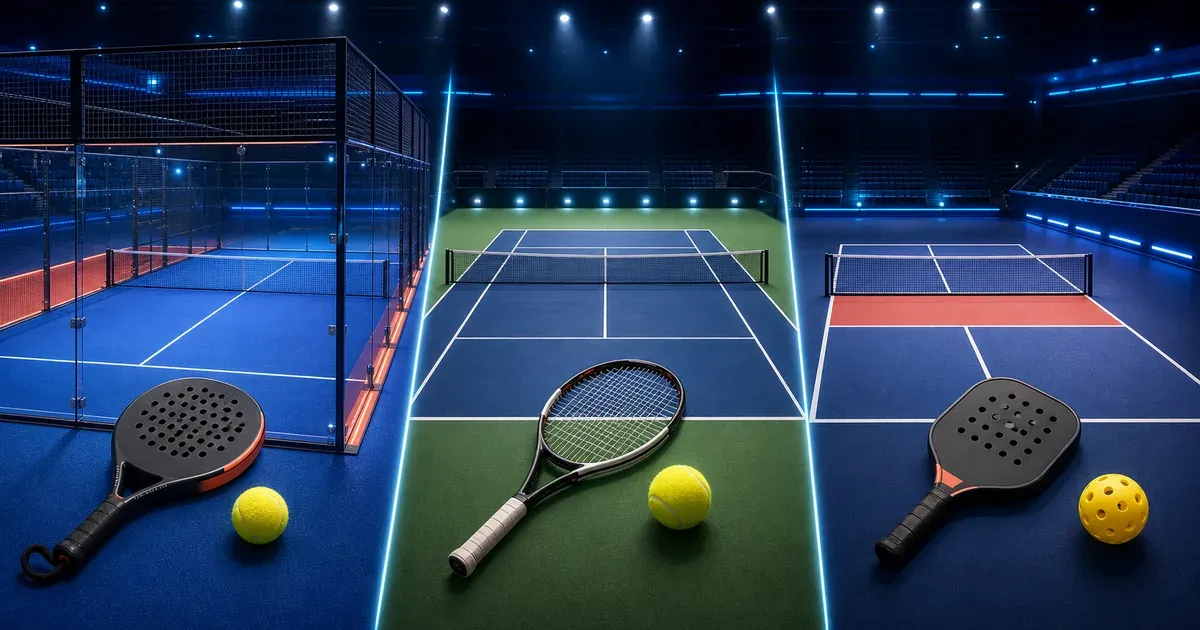
A friend invites you to padel on Tuesday, your local leisure centre has just painted pickleball lines over its old tennis courts, and you are still not sure what separates any of them from the tennis you played at school. That confusion is reasonable. All three are played with a racket or paddle, a net and a bouncing ball, and from a distance they can look interchangeable.
They are not. The court sizes differ by a factor of three, the scoring systems are built on different logic, and the physical demand ranges from a gentle Sunday hit to a genuinely punishing singles rally. Here is what actually separates padel, tennis and pickleball, and which one is worth your first session.
The fast version
Padel is played in doubles on an enclosed court about a quarter the size of a tennis court, with solid stringless paddles and walls the ball can bounce off legally. Tennis is played on an open court with a strung racket, full overhead serves, and the widest range of shot power and spin of the three. Pickleball is played on the smallest court, with a solid paddle, a perforated plastic ball, and rules built specifically to slow the game down near the net.
Padel
Padel is played on a walled court measuring 20m × 10m, usually in doubles. It uses a solid, stringless paddle and a low-pressure ball similar to a tennis ball. The scoring is tennis-style - 15, 30, 40 and game - but serves must be hit underarm and below waist height.
Tennis
Tennis is played on an open court. A singles court measures 23.77m × 8.23m, and the game can be played in either singles or doubles. Players use a strung racket and a pressurised felt ball, with tennis-style 15/30/40/game scoring and an overhead serve.
Pickleball
Pickleball uses the smallest court of the three, measuring 13.4m × 6.1m. It can be played in singles or doubles with a solid, stringless paddle and a hard, perforated plastic ball. Serves are underarm, and games are normally played to 11 points with a two-point margin required to win.
None of that tells you which one suits you. For that, you need to know how each sport actually plays.
Padel: forgiving walls, fast doubles, low technical barrier
A padel court is enclosed by glass and mesh walls, and the ball is allowed to bounce off them before a player returns it, in the same way a squash ball plays off the side walls. According to the International Padel Federation's official rules, the court measures 20 metres by 10 metres, with a net 0.88 metres high at the centre and 0.92 metres at the posts, and it is played almost exclusively in doubles.
The serve is underarm: the ball must be bounced first, then struck at or below waist height, which the FIP's current rules fix at 1.06 metres, and sent diagonally into the service box. Scoring then follows tennis exactly: 15, 30, 40, game, with sets decided the same way. The rule that changes the sport is what happens after the point starts. A defensive lob that would be a clean winner in tennis simply bounces off the back wall in padel and stays in play, which turns rallies into longer exchanges built on positioning and touch rather than raw power.
The paddle itself is solid, perforated and strung with nothing, so there is no string tension to learn and less that can go wrong with your equipment. Combined with the forgiving walls, that makes padel unusually easy to enjoy in your first session, even if the tactical depth (positioning at the net, using the glass deliberately, playing the lob) takes much longer to master. If padel sounds like the one to try, our guide to beginner-friendly padel rackets covers what to look for before you buy your first one.
Tennis: the widest range of shots, and the highest technical ceiling
Tennis is played on a court roughly four times the size of a padel court, with no walls to rescue a mishit shot. A singles court measures 23.77 by 8.23 metres, widening to 10.97 metres for doubles, with the net at 0.914 metres at the centre and 1.07 metres at the posts. Every point starts with a full overhead serve, and the scoring uses the same 15-30-40 sequence as padel, but with deuce and advantage at game point, and a tiebreak to settle a set that reaches 6-6 in most formats.
What tennis offers that the other two do not is range: full-swing groundstrokes, heavy topspin, sliced approaches, serves that can decide a point outright, and singles play that rewards fitness and shot-making in a way doubles-only sports cannot replicate. That range is also what makes tennis the hardest of the three to pick up. A strung racket demands a repeatable, technically correct swing before shots become consistent, and with no wall to extend a rally, early mistakes end the point rather than continuing it.
Tennis also asks the most of your body, particularly in singles, where you cover the full width and depth of the court alone for the length of a match. Doubles tennis is considerably gentler, closer in physical demand to padel, since the court is shared and rallies are shorter.
Pickleball: the smallest court and the fastest learning curve
Pickleball is played on a court the size of a doubles badminton court, 13.4 by 6.1 metres, which is small enough to fit inside a single tennis court with room to spare. USA Pickleball's official rules set the net at 0.86 metres at the sidelines and 0.91 metres at the centre, slightly lower than a tennis net. Both players use solid, stringless paddles, and the ball is hard plastic with holes through it, similar to a wiffle ball, which travels more slowly through the air than a tennis or padel ball.
Two rules define how the game is actually played. The double-bounce rule requires the ball to bounce once on each side before either player can volley it, which removes the serve-and-volley rush that exists in tennis. The non-volley zone, nicknamed “the kitchen,” is a 2.1-metre strip either side of the net where players cannot volley the ball, which stops the net-crowding smash exchanges that would otherwise dominate a court this size. Scoring is traditionally side-out: only the serving side can score a point, games are usually played to 11, win by 2, though some recreational and tournament formats use rally scoring instead, where every rally wins a point regardless of who served.
The combination of a small court, a slower ball and rules that actively discourage power at the net is what makes pickleball the fastest sport of the three to feel competent at. Most beginners can sustain a real rally within their first session, which is a large part of why it has spread so quickly through parks, leisure centres and repurposed tennis courts.
Comparing the things that actually decide your choice
Learning curve
Pickleball is the quickest to pick up: the small court and forgiving pace mean a first-timer can rally within minutes. Padel comes next, since the walls forgive mishits that would end a point outright in tennis, but reading the glass and playing an effective lob take longer to develop. Tennis has the steepest learning curve of the three, because a strung racket and an open court punish technical errors immediately.
Physical demand
Singles tennis is the most physically demanding of the three by a wide margin: full-court coverage, long rallies and repeated sprinting. Padel and doubles tennis sit closer together, since both are played by two players covering half a court each. Pickleball places the least strain on the body among the three, largely because the court is small and points are usually shorter, which is a significant reason it has become popular with older players and people returning from injury, though it still involves quick lateral movement and should not be treated as a purely sedate activity.
Equipment and cost to start
Pickleball paddles and balls are generally the cheapest way into any of the three sports, and courts are increasingly common as leisure centres convert existing tennis or badminton courts. Tennis rackets range enormously in price, but public tennis courts are widely available in most towns. Padel is usually the most expensive to start, both because dedicated padel courts (built with the correct wall and glass specification) are less common outside dedicated clubs, and because court hire per session tends to cost more than a public tennis or pickleball booking.
Social format
Padel is built around doubles; playing singles padel is unusual and not how the sport is generally organised. Pickleball is also most commonly played in doubles, though singles is a recognised format. Tennis is the only one of the three where singles is the default competitive format, while still supporting doubles for a more social game.
Which one should you actually play?
If you already play tennis and want something more social with a gentler learning curve for a mixed-ability group, padel is the natural next step: the walls keep rallies alive, doubles is the standard format, and many of your tennis instincts around positioning transfer directly.
If you want the fastest route to feeling genuinely competent, the lowest physical impact, and the cheapest equipment to try, pickleball is the easiest recommendation. It is also the most forgiving sport for mixed-ability groups, since the small court and slower ball narrow the gap between a complete beginner and someone who has played a handful of times.
If you want the deepest technical and tactical ceiling, a path into structured competition, or the option to play a serious singles match, tennis remains the strongest choice. It takes longer to become consistent, but no other racket sport offers the same range of shots or the same singles format at every level from beginner to professional.
If you are not sure yet, the practical answer is to try pickleball first, since it requires the least commitment to feel like you are actually playing rather than just retrieving the ball, then decide whether you want more shot-making range (tennis) or more social doubles with forgiving walls (padel).
Frequently asked questions
Is padel easier to learn than tennis?
Most beginners find padel easier to start with, mainly because the walls keep the ball in play after a mishit and the underarm serve removes the timing challenge of a tennis serve. The tactical side of padel, particularly using the glass deliberately and playing an effective lob, still takes time to develop.
Is pickleball a good replacement for tennis if my knees can't handle it?
Pickleball's smaller court and shorter rallies generally place less strain on the body than singles tennis, which is why it is often recommended to players managing joint issues or returning from injury. It still involves lateral movement and stopping and starting, so it is not a no-impact activity, and anyone with a specific injury should get individual guidance rather than relying on a general comparison.
Can I use a tennis racket to play padel or pickleball?
No. Both padel and pickleball are played with solid, stringless paddles rather than a strung racket, and the different weight, balance and hitting surface change how the ball responds. A tennis racket is also the wrong size and shape for either sport's rules.
Which sport is cheapest to start playing?
Pickleball is usually the cheapest to begin, since paddles are inexpensive and an increasing number of venues have converted existing courts. Tennis equipment and public court access are also generally affordable. Padel tends to cost more per session, partly because dedicated courts with the correct wall specification are less widely available outside padel clubs.
Can pickleball, padel and tennis all be played outdoors?
Yes, all three are played outdoors as well as indoors, though padel courts need the correct wall and glass construction regardless of setting, which makes outdoor padel courts a bigger investment to build than an outdoor tennis or pickleball court.
Try one before you commit to equipment
The court size, scoring system and physical demand differ enough between padel, tennis and pickleball that reading about them only gets you so far. Book a single taster session in whichever one matches what you are actually looking for, sociable doubles, a fast beginner ramp, or the deepest competitive ceiling, before spending on equipment.
If you and a regular group settle on padel or tennis, Fixture.cc's padel fixture generator and tennis fixture generator can turn a rotating group of players into a proper schedule once you are past the first few sessions.
Our editorial process
How we research and review our content
Our research process depends on the subject. We select the sources that can answer the article's actual question, cross-check important claims, and distinguish documented facts from editorial judgement.
- Practical context and direct experience
- We draw on our team's experience of sports, equipment, and organising competitions when it is relevant. Direct use informs our judgement only where it actually occurred; we do not present research as hands-on testing.
- Primary and authoritative sources
- Depending on the topic, we consult governing-body rules, official guidance, manufacturer specifications and manuals, standards, technical documentation, and other first-party sources.
- Independent and public evidence
- For comparisons and recommendations, we may examine specialist reviews, public customer feedback, retailer information, ratings, and recurring real-world issues. We cross-check patterns and never treat one comment or score as proof.
- Editorial review and updates
- We compare the available evidence with the reader's likely needs, explain uncertainty and trade-offs, verify important claims, and update content when rules, products, features, or source information change.
Share this article
Send this guide to someone who might find it useful.

About the author
Fixture.cc editorial team
The Fixture.cc editorial team is a global group of sports enthusiasts creating practical, trustworthy guides for sports fans, competition organisers, coaches, and teachers.
View editorial profileKeep reading
Related articles
What Is a Bye in Sports? Rules, Examples and Calculation
Learn what a bye means in knockout, round-robin and Swiss tournaments, how many byes a bracket needs, and how to award them fairly.
Best of 3 vs Best of 5: Which Esports Series Format Should You Use?
Bo1, Bo3 or Bo5? How each esports series format changes match count and event length, and how to pick the right one for your bracket or league.
How to Embed a Live League Table on Your Website or Facebook Group
Add a live, self-updating league table to your club website with one embed code, and the right way to share it on Facebook, where iframes don't work.