How to Organise a Youth Football Tournament: Complete Guide
Plan a safe, well-run youth football tournament with practical advice on formats, fixtures, budgets, volunteers, safeguarding and match-day operations.
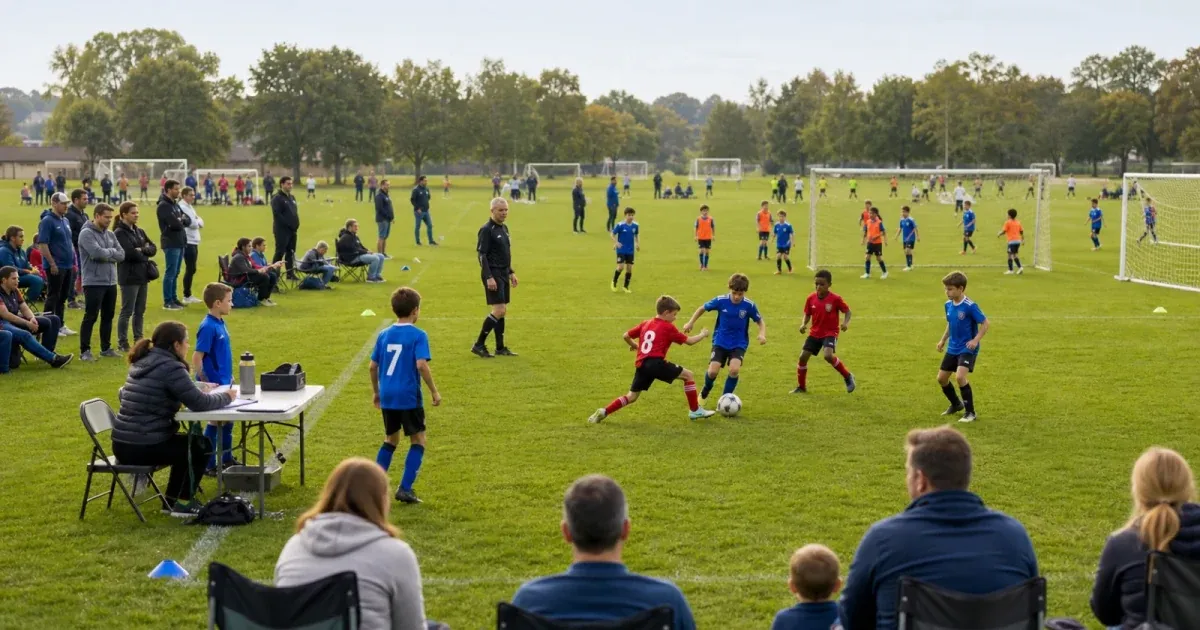
Organising a youth football tournament is not mainly a fixture-making exercise. The fixtures matter, but most tournament problems begin somewhere else: too many teams for the venue, rules that were never properly agreed, volunteers who do not know who is in charge, or a timetable with no room for one late kick-off.
A well-run tournament feels simple to the teams attending. Coaches know where to go. Parents know where to park. Referees know which rules apply. Results appear without confusion. Children get enough football without spending the whole day waiting for their next match.
That simplicity is created before the first whistle.
To organise a youth football tournament properly, you need to:
- confirm the age group, competition rules and required approval
- decide how many teams and pitches the venue can genuinely support
- choose a format that gives players a worthwhile amount of football
- build a schedule around player rest, not only pitch availability
- assign safeguarding, medical and operational responsibility to named people
- communicate one clear version of the rules, fixtures and venue information
- prepare for delays, injuries, severe weather and technology failure
This guide uses football to mean association football, also called soccer in some countries. Youth competition requirements are not universal. Match duration, pitch size, ball size, substitutions, heading restrictions, player eligibility, safeguarding checks and medical provision can differ by country, association, age group and season.
The IFAB specifically allows national football associations to modify several organisational parts of the Laws for youth football, including field size, ball specifications, goal dimensions, match duration, player numbers and return substitutions. Always use the rules issued for the host location and current season rather than copying another tournament's regulations. See the current IFAB Laws of the Game and its guidance on permitted youth-football modifications.
1. Decide exactly what the tournament is promising
Before booking referees, ordering medals or inviting clubs, write a one-page event brief. This forces the important decisions into the open while they are still easy to change.
Your brief should answer:
- Which age group or age groups can enter?
- Is the tournament recreational, development-focused, competitive or a fundraiser?
- Is it mixed, girls', boys' or open under the applicable rules?
- How many teams will be accepted?
- What is the maximum squad size?
- How many matches is each team guaranteed?
- How long will each match be?
- Will the event last half a day, a full day or a weekend?
- Which pitches and facilities are available?
- What is the entry fee, and what does it include?
- Who has final authority on operational decisions?
The phrase guaranteed matches matters. “An eight-team tournament” tells a coach very little. “An eight-team tournament with four guaranteed matches per team” is a clear product.
That promise determines your format, required pitch time, referee appointments, entry fee and the amount of waiting families should expect.
Keep the first edition deliberately manageable
A common mistake is trying to make the first tournament look bigger than it needs to be. Several age groups, food vendors, raffles, entertainment, live results and finals on a main pitch can sound impressive. They also create several events that must all work at the same time.
For a first edition, one age group with six or eight teams is often easier to control than three age groups sharing pitches, volunteers and referees. When multiple age groups are included, treat each one as a separate competition with:
- its own coordinator
- its own fixture schedule
- clearly allocated pitches
- age-specific rules
- separate standings and result verification
The whole event may share a control point, but no age group should depend on one person mentally tracking everything.
2. Check approval, insurance and local rules before accepting money
Contact the football authority responsible for the event before you advertise confirmed details or collect entry fees. Depending on the country and level, this may be a national federation, regional association, state or provincial body, league, school authority or another recognised organiser.
Ask direct questions:
- Does the tournament require sanctioning or written approval?
- Which competition rules must be used?
- Are there limits on match duration or total daily playing time?
- Which age eligibility date applies?
- Are squad lists or player registrations required?
- Are guest players permitted?
- Can one player represent more than one team?
- Which substitution rules apply?
- Are there age-specific heading or restart rules?
- What qualifications or registration must referees hold?
- What safeguarding checks are required for staff and volunteers?
- What medical or first-aid provision is required?
- What insurance must the organiser, venue and participating clubs hold?
- Are there extra requirements for teams travelling from another region or country?
Do not rely on “this is how we did it last year.” Ask for the current regulation, policy or written confirmation.
Build safeguarding into the tournament structure
Safeguarding should not be a paragraph added to the rules pack shortly before the event. It affects recruitment, supervision, photography, changing areas, lost-child procedures, transport, reporting and the way adults communicate with children.
FIFA's Guardians safeguarding guidance emphasises accountability, risk assessment, safeguarding plans and good practice for staff and volunteers working with children. Your tournament must also follow the host country's law and the policies of the relevant football authority.
At minimum, establish:
- a named safeguarding lead and deputy
- a visible reporting point
- a private way to raise a concern
- a lost-child and unaccompanied-child procedure
- clear rules for changing areas and toilets
- a photography and video policy
- rules for adult-to-child communication
- the required vetting or background checks
- an escalation route for concerns that cannot be handled by the organiser
The safeguarding lead should not also be the only person running fixtures, parking and referee payments. They need enough capacity to act properly if a concern is raised.
3. Build a budget that survives a few empty places
Separate your costs into three groups.
Fixed costs
These remain broadly the same whether six teams or eight teams attend:
- venue hire
- permits or sanctioning fees
- insurance
- equipment hire
- toilets or waste services
- radios or communication equipment
- signage and printing
- website or payment setup
Variable costs
These increase as the tournament grows:
- referee fees
- medals, trophies or participation awards
- food or drink supplied to officials and volunteers
- payment-processing fees
- extra medical cover
- additional pitches or changing rooms
- cleaning and waste collection
Contingency
Keep a separate amount for costs that are easy to overlook:
- replacing damaged equipment
- an additional hour of venue hire
- last-minute printing
- an extra referee
- emergency water, ice or shelter
- refunds or supplier cancellation charges
Use a conservative estimate for paid entries. If the tournament only breaks even when every team pays, every vendor appears and the weather is perfect, the plan is too fragile.
A simple break-even calculation is:
required paid teams = total expected cost ÷ net income per team
If the tournament is expected to cost 2,400 and the organiser receives 300 per team after payment fees, eight paid teams are needed merely to break even. That leaves no room for a late withdrawal or unexpected expense.
Set the fee only after you understand the cost per team and the experience you are providing. Coaches are more likely to accept a fair fee when the invitation clearly states the number of guaranteed matches, match duration, facilities and what is included.
Publish the refund policy with registration
State what happens when:
- a team withdraws before the closing date
- a team withdraws after fixtures are published
- the organiser cancels the event
- the venue becomes unusable
- weather stops part of the tournament
- a team is removed for an eligibility or disciplinary issue
Do not leave these decisions until money has already been spent.
4. Test the venue against the tournament, not the other way around
A venue is not suitable merely because you can draw enough rectangles on a map. Walk the site with the proposed schedule in mind.
Check:
- pitch dimensions appropriate to each age group
- safe run-off space around every pitch
- secure goals of the correct size
- separation between active pitches, warm-up areas and spectators
- safe team and referee areas
- toilets, handwashing and drinking-water access
- accessible routes and facilities
- first-aid and safeguarding points
- shade, shelter or indoor space appropriate to likely conditions
- parking, public transport and drop-off arrangements
- emergency-vehicle access that cannot be blocked by parked cars
- mobile signal, power and internet availability
- waste collection and food-service areas
- how children move between pitches without crossing live play or traffic
Stand at the busiest point and picture several matches ending together. Teams will leave pitches, the next teams will arrive, parents will move, scores will be reported and some children will head to the toilets. A route that seems perfectly adequate during a quiet site visit can become congested every 25 minutes.
Record the emergency location precisely
Do not assume that “the football club” is enough for emergency services. Record:
- the full address
- the correct entrance
- a gate or access code where relevant
- map coordinates or the locally accepted location reference
- the route to each pitch
- who will meet the emergency vehicle
Keep the access route clear throughout the event, not only at opening time.
Confirm who decides whether the pitches are playable
Agree this with the venue in advance. The decision might belong to the grounds team, facility manager, match officials, tournament director or another authorised person. Record:
- who makes the decision
- when the first inspection will happen
- how often conditions will be reviewed
- how teams will be informed
- whether an alternative pitch or date exists
Unclear authority creates dangerous delays when conditions deteriorate.
5. Choose a format around the player experience
The best format is not necessarily the one that produces the most dramatic final. It is the one that fits the available time, complies with local playing limits and gives children a worthwhile day.
Straight knockout
A knockout requires relatively few matches and creates a clear competition. Its weakness is obvious: half the teams lose their first match. It is usually a poor choice when families have travelled a long distance unless consolation matches are included.
Full round robin
Every team plays every other team. This is fair and easy to understand, but the match count grows quickly.
For a single round robin:
total matches = teams × (teams − 1) ÷ 2
Examples:
| Teams | Total matches | Matches per team |
|---|---|---|
| 4 | 6 | 3 |
| 6 | 15 | 5 |
| 8 | 28 | 7 |
| 10 | 45 | 9 |
An eight-team round robin sounds simple, but 28 matches can overwhelm a one-day event unless several pitches are available and short match lengths are permitted.
Groups followed by placement matches
For many one-day youth tournaments, groups followed by finals or placement matches provide the best balance.
With eight teams, two groups of four create 12 group matches. Each team plays three group matches. The second phase can then provide:
- semi-finals and a final
- classification matches for every finishing position
- a top and lower bracket
- a single placement match per team
This format gives each team at least four matches while keeping the total manageable.
Development festival
For younger age groups, a non-elimination festival may be more suitable. Teams rotate through scheduled matches without a public championship table or final. Whether scores and standings should be recorded depends on local policy.
The advantage is that the day remains focused on participation and equal playing opportunities rather than tournament progression.
6. Calculate whether the schedule actually fits
Before drawing fixtures, calculate the venue's realistic match capacity.
A basic formula is:
available match slots = pitches × usable minutes ÷ minutes per slot
Suppose you have:
- 2 pitches
- 6 hours of usable playing time
- 30-minute slots
The theoretical capacity is:
2 × 360 ÷ 30 = 24 match slots
Do not immediately schedule 24 matches. That number assumes every match begins exactly on time and uses the entire venue window. You still need space for:
- a delayed kick-off
- checking final group standings
- a pitch inspection or minor repair
- moving goals or changing field markings
- the transition into knockout matches
- presentations and site clearance
A practical schedule should include deliberate buffer periods rather than treating every minute as sellable capacity.
A slot is longer than the match
A 20-minute match does not automatically fit into a 20-minute slot. Teams must leave the pitch, the score must be confirmed, the next teams must enter and the referee may need a brief conversation with the control point.
A tournament might therefore use:
- 20-minute match in a 25-minute slot
- 25-minute match in a 30-minute slot
- two timed halves plus a clearly defined half-time and changeover
The correct choice depends on local rules and the age group. The principle is universal: schedule the full operational cycle, not just the ball-in-play time.
Measure rest from the end of one match to the start of the next
Fixture software can show that a pitch is free without noticing that a team has just finished on another pitch.
Audit every team for:
- simultaneous fixtures
- back-to-back matches
- unequal rest compared with group opponents
- unrealistic travel between pitches
- a long wait followed by several short turnarounds
- a final immediately after a semi-final
Use the minimum rest and daily playing limits required by the relevant authority. Where the rules allow discretion, avoid treating the shortest possible rest as the target. Children need time to drink, eat, use the toilet, receive coaching and recover emotionally as well as physically.
7. A practical eight-team tournament example
Here is a simple structure for eight teams using two groups of four.
Group stage
Each group contains four teams. A four-team round robin requires six matches, so the two groups require 12 matches in total.
Each team plays three group matches.
Second phase option A: four placement matches
- 1st Group A vs 1st Group B: final
- 2nd Group A vs 2nd Group B: third-place match
- 3rd Group A vs 3rd Group B: fifth-place match
- 4th Group A vs 4th Group B: seventh-place match
Total tournament matches: 16
Matches per team: 4
This is efficient, every team gets the same number of matches, and the final positions are easy to explain.
Second phase option B: semi-finals and classification matches
- semi-final 1: 1st Group A vs 2nd Group B
- semi-final 2: 1st Group B vs 2nd Group A
- final and third-place match
- equivalent placement matches for teams finishing third and fourth in their groups
This gives more knockout drama but requires more matches and careful rest planning. Do not add a full bracket simply because it looks better on paper. Count the slots first.
Example operating rhythm
With two pitches, group matches can often be paired so that both groups progress at a similar rate. After the group stage, include a buffer long enough to:
- receive the final scores
- resolve any permitted protest
- verify tie-break calculations
- publish the second-phase fixtures
- give qualifying teams the required rest
Never publish a semi-final based on an unofficial table and then ask teams to swap after they have started warming up.
You can use Fixture.cc's group-stage and knockout generator to build the group schedule, assign pitches and times, publish fixtures and update results during the tournament.
8. Write rules for the disputes you can predict
Good tournament rules are not long for the sake of being long. They are precise where disagreement is likely.
Cover:
Eligibility and registration
- age cut-off and permitted proof of eligibility
- squad size and registration deadline
- guest-player rules
- whether a player can appear for more than one team
- who may stand in the technical area
- what happens when a team fields an ineligible player
Match operation
- number of players
- minimum players required to start or continue
- match duration and half-time
- substitution procedure
- kick-off procedure
- ball size
- home-team responsibilities
- kit clashes and goalkeeper colours
- late arrival and grace period
Group standings
State the points system and exact tie-break order. For example:
- points
- goal difference
- goals scored
- head-to-head criteria, where authorised
- another method permitted by the competition rules
Do not use “and so on” or “organiser decision” in the middle of a tie-break sequence. Decide it before the tournament.
Consider whether the competition should cap the goal difference counted from a single match. A cap can reduce the incentive to chase an excessive score against a weaker team, but it must be permitted and published in advance.
Knockout matches
Explain how a draw is resolved:
- extra time, if permitted
- kicks from the penalty mark
- another authorised method
Include the number or sequence of kicks only if it matches the rules you are using.
Discipline and behaviour
Cover:
- cautions and dismissals
- whether cautions accumulate
- suspensions
- coach and spectator misconduct
- removal from the venue
- who can report an incident
- who makes the disciplinary decision
A behaviour code is only useful when teams know the consequence of ignoring it.
Delays, abandonment and severe weather
Define:
- who can suspend play
- when a match may be shortened, if ever
- what happens to an abandoned match
- whether completed results stand
- how the schedule may be restructured
- how teams are notified
Do not improvise these rules during a thunderstorm.
Protests and corrections
State:
- who may submit a protest
- the deadline
- the accepted method
- whether a fee applies under local rules
- who decides
- when the decision is final
Keep the process fast enough for a one-day tournament. A protest system that requires a committee meeting the following week cannot resolve a semi-final starting in 20 minutes.
9. Make safety and medical planning operational
A generic sentence saying “first aid will be available” is not an emergency plan.
Prepare a written event risk assessment with the venue and competent leads. Consider:
- goal safety
- field condition and surface hazards
- severe weather
- heat, cold and air quality
- traffic and parking
- crowd movement
- missing children
- medical emergencies
- fire and evacuation
- food handling
- blocked emergency access
- equipment failure
- power, internet or communication failure
FIFA promotes a standardised Pre-Match Emergency Action Plan for pitchside emergencies. Your event plan should be appropriate to the venue, level of competition and local medical requirements.
The people expected to act should know:
- who takes control
- who calls emergency services
- who provides immediate care
- where first-aid equipment is stored
- whether an automated external defibrillator is available and where it is
- who meets and directs the ambulance
- how play is stopped across the site
- how parents or team officials are informed
- how the incident is recorded
Test radios, phones or the chosen communication method before the first match.
Treat suspected concussion seriously
FIFA and the World Health Organization's Suspect and Protect campaign states that a person showing one or more concussion symptoms should leave the pitch immediately and be seen by a doctor as soon as possible. Symptoms can appear later, and return to play should follow medical guidance.
Use the current concussion protocol recognised in the host country. Tournament progression, a short bench or an important final is never a reason to return a child early.
The organiser should also have a clear process for passing relevant incident information to the child's responsible adult and recording what happened.
10. Give every critical job to a named person
“The committee will handle it” is not a match-day structure.
Assign named leads for:
- tournament direction
- safeguarding
- medical or first aid
- referee coordination
- fixtures and results
- venue and equipment
- team registration
- parking and spectator movement
- volunteers
- communications or announcements
- finance and supplier payments
Give critical roles a deputy. The tournament director may be dealing with an injured player, an angry coach or a venue problem when the next decision is needed.
Use a simple command structure
Everyone should know:
- who has final operational authority
- which decisions referees make
- which decisions belong to the venue
- who can change a fixture
- who can stop play across all pitches
- who handles safeguarding concerns
- who speaks publicly for the tournament
Confusion becomes visible when three volunteers give the same coach three different answers.
Brief volunteers around situations, not only tasks
A volunteer may know they are “on the information desk” but still not know what to do when:
- a child cannot find their team
- a parent reports unsafe behaviour
- a coach disputes a result
- a referee does not arrive
- an ambulance needs access
- a pitch becomes unavailable
Give volunteers a short escalation card with names, roles and contact numbers. They do not need to solve every problem. They need to send each problem quickly to the right person.
Look after referees
Confirm referees early and tell them:
- age group and playing format
- match duration
- relevant local variations
- reporting process
- arrival and briefing time
- number of appointments
- payment method
- expected breaks
Provide water, food or refreshments appropriate to the shift, shelter, a secure changing area where available and enough time to move between pitches.
Build a fallback for referee absence. This must comply with local competition rules; do not assume an unregistered volunteer can simply take over.
11. Make registration easy to verify
The registration form should collect only information you need to organise the tournament and meet legal or governing-body requirements.
Typical team-level information includes:
- club and team name
- age group
- named team contact
- contact details
- kit colours
- estimated arrival method
- invoice or payment details
- acknowledgement of rules and policies
Player-level information depends on local requirements. Avoid collecting sensitive data simply because it may be useful later. Restrict access, store it securely and decide when it will be deleted.
Do not confirm a place ambiguously
Use a clear status:
- application received
- place provisionally held
- payment due
- entry confirmed
- waiting list
- withdrawn
Coaches should never discover two weeks before the event that submitting a form did not reserve a place.
Set deadlines for:
- entry application
- payment
- squad submission
- eligibility documents
- withdrawal with refund
- final changes
If you do not already have a club registration system, Fixture.cc can open a public registration form for the competition, add custom questions and keep confirmed, waiting-list and withdrawn entries together. That is useful for collecting team details, but the organiser should still verify eligibility documents and payments through the process required locally.
12. Send one team information pack
Teams should not have to reconstruct the tournament from an email thread, three social posts and a messaging group.
Send one authoritative pack or page containing:
- confirmed rules
- fixtures and check-in time
- venue address and correct entrance
- transport, parking and drop-off information
- site map
- pitch locations
- toilets, first aid, safeguarding and information points
- squad and consent requirements
- kit requirements
- food and water availability
- behaviour expectations
- photography policy
- severe-weather and cancellation process
- match-day contact details
- the time and channel for updates
Ask one named contact from each team to acknowledge receipt. Operational changes should go to those contacts at the same time.
Use a simple version number or update timestamp on the pack. If a fixture changes, replace the old version rather than circulating another attachment with a nearly identical filename.
For the information that changes during the day, the Fixture.cc football competition page gives teams one link for fixtures, results and standings. Sharing its QR code in the pack and at the venue lets families reopen the current version instead of relying on an old screenshot.
13. Audit the fixtures from four perspectives
Once the draw is complete, test the schedule carefully.
Team audit
For every team, check:
- no overlap
- required rest is met
- no unreasonable sequence of pitch changes
- similar rest to group opponents
- no accidental early departure followed by a late placement match
- a realistic route from check-in to the first match
Pitch audit
For every pitch, check:
- no duplicate slot
- correct age group and field dimensions
- enough transition time
- a buffer before decisive rounds
- time for inspection or maintenance
- no use beyond the venue booking
Referee audit
For every official, check:
- no overlap
- enough travel time
- appropriate breaks
- a sensible number of consecutive appointments
- the correct qualification or eligibility for the assigned age group
Control-point audit
Check whether the results team can realistically:
- receive each score
- investigate a discrepancy
- update standings
- verify qualifiers
- publish the next round
- answer team questions
If six group matches end simultaneously and the semi-finals begin five minutes later, the spreadsheet may be valid but the operation is not.
14. Prepare the final week as if the internet might fail
In the final week, confirm every team, referee, supplier, volunteer and venue contact. Do not treat silence as confirmation.
Prepare offline copies of:
- contact lists
- squad lists
- fixtures
- rules
- site plan
- emergency action plan
- incident and safeguarding forms
- result sheets
- standings templates
- referee appointments
- payment records
Label equipment by pitch. Depending on local rules and venue provision, this may include:
- suitable match balls and spares
- pumps and pressure gauges
- corner flags
- training vests or bibs
- whistles and timing devices
- score cards
- pitch signs
- barriers or spectator markers
- radios and chargers
- stationery and clipboards
Inspect goals, nets, markings and access routes with the venue where possible. Charge devices, test login access and keep paper fallbacks.
Use a final confirmation call or message
Ask each team to confirm:
- attendance
- squad status
- arrival time
- primary contact
- kit colours
- awareness of the latest fixtures and rules
A withdrawal discovered before the event can be handled. A withdrawal discovered when the opponent is waiting on the pitch affects the entire schedule.
15. Run match day from one control point
The control point should be the tournament's operational source of truth.
It should hold:
- the official fixture list
- the official results record
- current standings
- contact details
- incident forms
- lost-property records
- radio or communication access
- the authority to publish approved changes
Open team check-in early enough for documents to be checked without delaying warm-ups. Hold a short referee briefing and a separate volunteer briefing before play begins.
Use one results process
A reliable process is:
- referee or authorised field marshal submits the result
- results desk records it
- discrepancies are resolved before publication
- standings are recalculated
- qualifiers are independently checked
- the next round is published through the agreed channel
Do not accept several competing sources of truth. A photograph of a scoreboard, a coach's message and a referee's card should not all be treated as equal official records.
With Fixture.cc, the results desk can enter a score after it has been approved and let the public standings or bracket update from that one record. If the venue has a suitable screen, TV mode can show the current fixtures and standings without creating a second display to maintain.
Keep a decision log
Record significant changes:
- fixture moved
- result corrected
- match abandoned
- protest received
- player eligibility decision
- disciplinary action
- schedule shortened or restructured
Write down who approved the decision and when. This prevents later arguments about what was said beside a pitch.
Monitor the parts of the event that do not appear in the fixture list
Walk the venue. Check:
- water availability
- toilet condition
- waste and food areas
- spectator behaviour
- blocked walkways
- emergency access
- warm-up areas
- referee welfare
- whether volunteers need relief
A tournament can be perfectly on time and still be poorly run.
16. Have a delay plan before you are delayed
Small delays are normal. The question is whether they remain small.
Build a priority order for recovering time. Depending on your published rules and local requirements, options may include:
- using an existing buffer
- moving a match to an available suitable pitch
- changing the order of matches without reducing required rest
- simplifying presentation arrangements
- restructuring later rounds under a pre-published contingency format
- shortening matches only where permitted and safely communicated
Never quietly reduce youth match lengths, breaks or rest because the event is behind schedule. A change affecting teams should be authorised, recorded and communicated to coaches and officials at the same time.
Use a clear update format
Every operational update should answer:
- what changed
- which teams or pitches are affected
- the new time or instruction
- when the next update will be issued
- where the official schedule can be checked
Avoid vague messages such as “everything is running about 20 minutes late.” Some pitches may not be late, and teams will arrive at the wrong time.
17. Close the tournament properly
Before the presentation, verify the final result and any individual awards. Keep the ceremony organised and short enough for tired players and families.
After the final whistle:
- confirm that children leave under the agreed team or guardian arrangements
- clear and inspect the venue
- collect equipment and lost property
- pay outstanding officials and suppliers
- reconcile income and costs
- store incident and safeguarding records securely
- make required reports to the governing body, venue or insurer
- delete participant information when the retention period ends
Ask team contacts a few focused questions:
- Was the pre-event information clear?
- Was check-in easy?
- Did the schedule feel fair?
- Did players get enough football?
- Were waiting times reasonable?
- Was the venue easy to navigate?
- What caused the most frustration?
- Would the team return?
Write a short handover document while the details are still fresh. Record what ran late, which role was understaffed, what equipment was missing and which communication worked. Next year's organiser needs honest operational notes, not only a folder of final fixtures.
A realistic planning timeline
Exact lead times depend on the venue and approval process, but the order below is reliable.
Three to six months before
- define the tournament and guaranteed player experience
- contact the governing body
- reserve the venue and backup date where possible
- draft the budget
- appoint tournament, safeguarding and medical leads
- begin the risk assessment
- confirm insurance requirements
Six to twelve weeks before
- publish the invitation and registration terms
- recruit referees and volunteers
- confirm suppliers
- draft the rules
- map the venue
- prepare safeguarding and emergency procedures
- monitor paid entries against break-even
Two to four weeks before
- close entries
- verify eligibility requirements
- make the draw
- build and audit fixtures
- allocate referees and volunteers
- finalise the site plan
- send the team pack
Final week
- reconfirm every team and official
- inspect the venue
- prepare equipment and paperwork
- check the weather and venue conditions
- test communications
- print offline backups
- brief staff and volunteers
Within one week afterwards
- complete reports and payments
- review incidents
- collect feedback
- record improvements
- reconcile the budget
- handle participant data according to the retention policy
Youth football tournament checklist
Before opening entries, confirm that you can answer yes to these questions:
- Do we know which authority's rules apply?
- Is the event approved where approval is required?
- Does the venue fit the proposed age group and schedule?
- Can the budget survive at least one or two empty places?
- Is the number of guaranteed matches clearly stated?
- Does the format comply with playing-time and rest requirements?
- Are safeguarding and medical responsibilities assigned?
- Is emergency access protected?
- Are cancellation and refund terms published?
- Is one person responsible for the official fixtures and results?
Before match day, confirm:
- every team has acknowledged the final information pack
- every referee and volunteer has confirmed attendance
- fixtures have passed team, pitch, referee and control-point audits
- the venue has been inspected
- goals and equipment are safe
- emergency communication has been tested
- paper backups are ready
- the severe-weather decision process is understood
- the control point has one official version of every document
Common mistakes that create avoidable problems
Inviting teams before checking the rules
A late discovery about age eligibility, match duration, approval or insurance can force you to rebuild the tournament after teams have paid.
Selling more places than the schedule can support
The number of teams should be limited by safe pitch capacity, player rest and operational staffing, not by demand alone.
Treating every empty minute as a match slot
A schedule with no buffer assumes perfect conditions. One injury, late referee or disputed result can delay every later round.
Giving some teams much less rest than others
This usually happens when fixtures are checked by pitch rather than by team. Fairness is not only about opponents; it is also about recovery time.
Publishing incomplete tie-break rules
Teams should not discover after the group stage whether head-to-head or goal difference comes first.
Running results through several messaging channels
Use one official record and one approved publication channel. Otherwise old screenshots and forwarded messages will continue circulating after a correction.
Depending on one indispensable organiser
If one person alone understands the fixtures, payments, safeguarding procedure and venue agreement, the event has no resilience.
Focusing on the final more than the whole day
For most children, the tournament experience is the group matches, time with teammates and how adults behave around them. A polished trophy presentation does not repair hours of waiting or chaotic communication.
Frequently asked questions
How far in advance should a youth football tournament be organised?
Many community tournaments need several months of preparation because approval, venue booking, insurance, safeguarding arrangements and referee recruitment can have long lead times. Begin by checking the deadlines set by the relevant football authority and venue; those deadlines should determine your timeline.
What is a good format for eight youth football teams?
Two groups of four followed by placement matches are often practical. The group stage requires 12 matches, and four placement matches give every team a fourth game. A semi-final structure can also work but requires more slots and careful rest planning.
How many matches are needed for a round-robin tournament?
For a single round robin, use teams × (teams − 1) ÷ 2. Six teams require 15 matches, while eight teams require 28. Each team plays one fewer match than the total number of teams.
How many pitches do I need for a youth football tournament?
It depends on the number of matches, slot duration and usable venue time. Calculate pitches × usable minutes ÷ slot length, then reserve time for delays, standings checks and presentations. Do not schedule the full theoretical capacity.
How long should youth tournament matches be?
There is no universal duration. Use the current rules for the age group and host association, including any limit on total daily playing time. Remember that the operational slot must be longer than the match itself.
How much rest should teams receive between matches?
Follow the minimum rest and daily playing limits set by the responsible football authority. When the rules leave discretion, avoid back-to-back matches and compare rest across all teams so one team is not repeatedly disadvantaged.
Do I need permission to run a youth football tournament?
Possibly. Requirements vary by country, region, association and event type. Contact the authority responsible for the participating teams before advertising confirmed rules, collecting fees or publishing fixtures.
What should be included in a youth tournament rules pack?
Include eligibility, squad registration, match operation, substitutions, standings, tie-breaks, knockout procedures, discipline, weather, abandoned matches, protests, safeguarding, photography and the organiser's decision-making process.
What should happen if bad weather stops play?
Follow the venue's safety process and the tournament's published contingency rules. The plan should identify who can suspend or abandon play, how teams are informed, whether results stand and how the remaining format or refunds will be handled.
How can I prevent a youth football tournament from running late?
Use realistic slots, include buffers, verify results quickly, keep one control point and avoid scheduling decisive matches immediately after the group stage. A written delay plan is more effective than trying to recover time by making unannounced changes.
How many footballs does a tournament need?
Provide at least one suitable match ball for every active pitch plus readily accessible spares. Confirm the required ball size and specification for the age group under the host association's rules.
Give the players a tournament worth returning to
The strongest youth tournaments are not remembered because every match started to the second. They are remembered because the day felt fair, safe and easy to understand.
Confirm the rules before taking entries. Promise only the number of teams and matches the venue can support. Protect rest periods. Give every important job to a named person. Keep one official version of the fixtures and results. Prepare for the predictable problems before families arrive.
Once those foundations are in place, create and publish the schedule with Fixture.cc's free football fixture generator.
Our editorial process
How we research and review our content
Our research process depends on the subject. We select the sources that can answer the article's actual question, cross-check important claims, and distinguish documented facts from editorial judgement.
- Practical context and direct experience
- We draw on our team's experience of sports, equipment, and organising competitions when it is relevant. Direct use informs our judgement only where it actually occurred; we do not present research as hands-on testing.
- Primary and authoritative sources
- Depending on the topic, we consult governing-body rules, official guidance, manufacturer specifications and manuals, standards, technical documentation, and other first-party sources.
- Independent and public evidence
- For comparisons and recommendations, we may examine specialist reviews, public customer feedback, retailer information, ratings, and recurring real-world issues. We cross-check patterns and never treat one comment or score as proof.
- Editorial review and updates
- We compare the available evidence with the reader's likely needs, explain uncertainty and trade-offs, verify important claims, and update content when rules, products, features, or source information change.
Share this article
Send this guide to someone who might find it useful.

About the author
Fixture.cc editorial team
The Fixture.cc editorial team is a global group of sports enthusiasts creating practical, trustworthy guides for sports fans, competition organisers, coaches, and teachers.
View editorial profileKeep reading
Related articles
What Is a Bye in Sports? Rules, Examples and Calculation
Learn what a bye means in knockout, round-robin and Swiss tournaments, how many byes a bracket needs, and how to award them fairly.

Best of 3 vs Best of 5: Which Esports Series Format Should You Use?
Bo1, Bo3 or Bo5? How each esports series format changes match count and event length, and how to pick the right one for your bracket or league.
How to Embed a Live League Table on Your Website or Facebook Group
Add a live, self-updating league table to your club website with one embed code, and the right way to share it on Facebook, where iframes don't work.