Best Pickleball Ball Machines for Garage and Small-Space Practice
Five compact pickleball ball machines for garages, driveways and short-court drills, with clear advice on space, noise, feeds and storage.
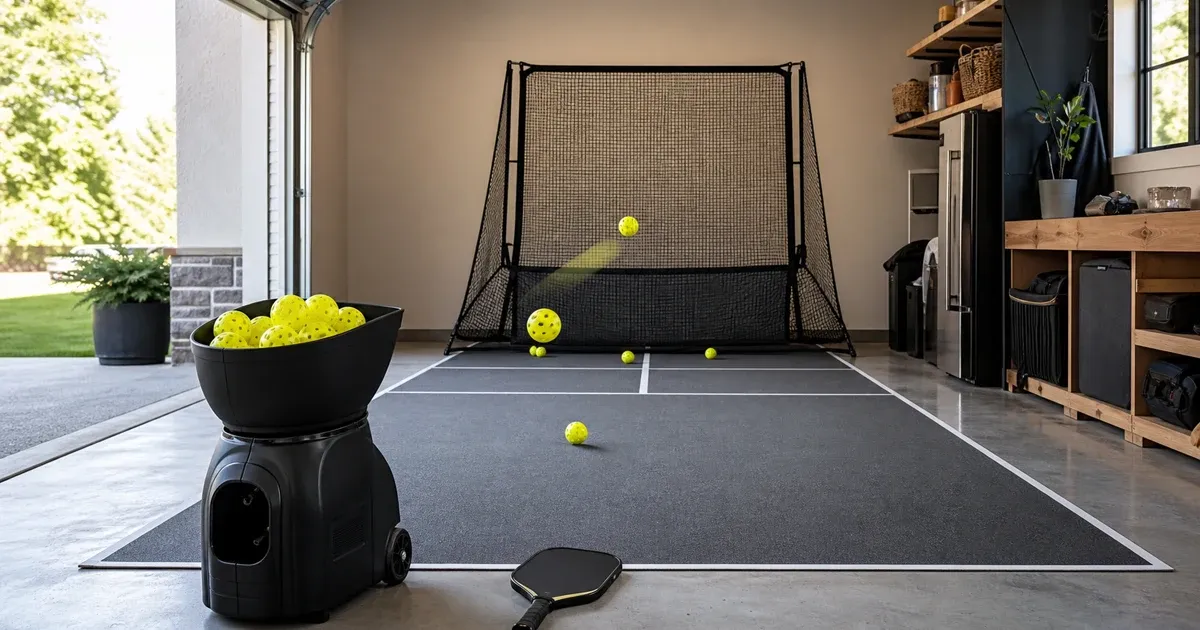
A garage is long enough to groove a dink, volley or compact drive, but it is not a miniature pickleball court. A machine that excels at deep, fast feeds can be awkward indoors, while a modest launcher with a slow minimum speed may produce far more useful practice.
For most home setups, the ERNE Dink + Drop Pro is the best fit. It packs down to 14 in (35.6 cm), weighs 17 lb (7.7 kg) and can feed as slowly as 5 mph (8 km/h), so it works for close-range touch drills without becoming dead weight when you want to take it to a court. The much simpler Franklin Sports ProShot Pickleballer is easier to justify for basic repetition, while the Titan ACE Pickleball Machine makes more sense if garage practice is only one part of a serious on-court training plan.
The five best compact pickleball ball machines at a glance
ERNE Dink + Drop Pro
The most convincing balance of low-speed control, compact storage and features you can still use on a full court. Its 45-plus-ball hopper is sensible for a garage rather than needlessly bulky.
Franklin Sports ProShot Pickleballer
A small, uncomplicated feeder for beginners who want repeatable contact practice and do not need spin, oscillation or app-programmed drills.
Sports Tutor Pickleball Mini
Compact enough to store without reorganising the garage, but capable enough for players who want adjustable speed, elevation and feed rate rather than a basic tosser.
Lobster The Pickle
A portable court machine with useful speed, spin and feed controls. It suits a larger garage or driveway better than a very short hitting lane.
Titan ACE Pickleball Machine
The choice for an ambitious player who needs compact transport and storage but still wants programmable drills, internal oscillation and full-court pace.
Measure the practice lane before choosing a machine
Usable length matters more than floor area
Measure from the machine's throwing opening to your contact point, then leave room behind you for a safe swing and in front of you for a catch or rebound net. A 20 ft (6.1 m) garage may provide considerably less than 20 ft of usable hitting length once shelving, the machine and the net are in place.
Slow feeds are essential at short range. A high maximum speed looks impressive in a specification list, but a low minimum speed and adjustable elevation determine whether you can practise resets rather than merely defend balls arriving too quickly.
Plan where every ball will finish
A ball machine is only half of an indoor setup. Use a properly tensioned rebound net or a deep catch net rated for ball practice, cover windows and move vehicles, tools and fragile storage out of the hitting line. Do not rely on a thin decorative screen to stop a driven pickleball.
Quiet practice balls can reduce the sharp plastic sound, although their flight and rebound may differ from a regulation ball. They are useful for repetition in a shared building, not a perfect simulation of match play.
Hopper capacity can become a nuisance
One hundred balls sound efficient until they spread under shelves and workbenches. For short-space drilling, a smaller hopper paired with a return net often creates a better rhythm. A large hopper earns its keep when you regularly move the machine onto a court.
Check storage size, not just playing size
Look at the machine with its hopper folded or removed. Also account for the charger, balls, net and any stand used to change the launch height. If the machine cannot remain accessible, the friction of unpacking it may quietly end your practice habit.
1. ERNE Dink + Drop Pro: the best garage-first design
The ERNE Dink + Drop Pro was designed around dinks, drops and close-range repetition rather than treating home practice as an afterthought. Its published speed range begins at 5 mph (8 km/h), and you can adjust speed, spin, frequency and elevation from a remote or phone.
That control matters in a garage. You can establish a comfortable feed, work on a compact motion and increase the demand gradually without moving the machine farther away. The unit holds more than 45 balls and runs from its battery for a claimed five to eight hours; for a normal home session, the practical advantage is simply that a cable does not cross your floor.
At 17 lb (7.7 kg) and 14 in (35.6 cm) tall when packed, it is the easiest serious machine here to place on a shelf or move between the garage and driveway. The limitation is equally clear: it is built for precision practice, not for reproducing the pace, capacity and sprawling random drills of the largest court machines.
2. Franklin Sports ProShot Pickleballer: useful repetition without a control panel
If your goal is to make cleaner contact rather than run a catalogue of drills, the Franklin Sports ProShot Pickleballer keeps the equipment out of the way. It is a compact automatic launcher powered by four D batteries or its mains adaptor.
There is no meaningful spin programming or court-wide oscillation to master. Set up a catch net, choose your position and use the consistent feed to rehearse paddle angle, ready position and contact in front of the body. That simplicity also makes it approachable for a family sharing one practice corner.
Its weakness is limited progression. Players who want varied depth, movement patterns and realistic topspin will outgrow it. Choose it because you want an affordable, small feeder, not because you expect the behaviour of a club-grade machine in a tabletop-sized package.
3. Sports Tutor Pickleball Mini: the compact middle ground
Some home players want more than a tosser but have nowhere sensible to store a large programmable machine. The Sports Tutor Pickleball Mini occupies that useful middle ground.
Adjustable ball speed, trajectory and feed interval let you configure a controlled volley or groundstroke drill, and the small body is easier to live with than a full-size hopper machine. Use restrained settings indoors; its extra range becomes more valuable when you roll it onto a driveway or court.
The trade-off is that compact does not mean featherweight, and optional features can change the exact configuration. Confirm the battery, oscillator and remote included with the listing available to you. This is the sensible step up when repeatable placement is no longer enough but app-based custom sequences would be unnecessary.
4. Lobster The Pickle: better when your small space includes a driveway
The Lobster The Pickle is portable in the wheeled, take-it-to-the-court sense rather than the put-it-on-a-shelf sense. Its adjustable speed, feed and spin give you far more scope than a simple home launcher, and the folding hopper helps when it is time to store it.
In a larger garage, the slower end of its range can support blocks and compact volleys into a net. It becomes much more worthwhile if you can open the door and extend the hitting lane along a safe driveway, where deeper feeds and oscillation have room to work.
This is not the best choice for a cramped single-car bay. It asks for more floor space, more balls and a larger stopping area than the two home-first options above. Buy it when one machine must cover both constrained practice and conventional court sessions.
5. Titan ACE Pickleball Machine: compact storage with full-court ambition
The Titan ACE Pickleball Machine is the premium answer for a player who stores a machine in the garage but does most serious drilling outside it. Its removable hopper inverts over the body, reducing packed height to 21 in (53.3 cm), while trolley wheels and an extendable handle make its 39 lb (17.7 kg) empty weight manageable.
On court, the case for it is much stronger: a 110-ball capacity, app-created drills, 12 pre-programmed drills, internal oscillation and a published 10–70 mph (16–113 km/h) speed range. Those are valuable features for movement, depth and pattern training.
Inside a short garage, most of that capability has to be dialled back. It is also the heaviest and most elaborate option in this guide. Choose it only if you know you will use its court programme; for dinks into a rebound net, the smaller machines are easier and more proportionate.
Which machine should you buy?
- Choose the ERNE Dink + Drop Pro when garage practice is the priority and you want precise slow feeds with room to progress.
- Choose the Franklin Sports ProShot Pickleballer for straightforward contact repetition with minimal setup.
- Choose the Sports Tutor Pickleball Mini when you want adjustable drills in a relatively compact conventional machine.
- Choose the Lobster The Pickle if your practice area regularly extends from the garage onto a safe driveway or court.
- Choose the Titan ACE Pickleball Machine if compact storage matters but advanced full-court training is the real reason for buying.
Frequently asked questions
How much room do I need for a pickleball ball machine in a garage?
There is no universal minimum because launch speed, trajectory and net position all change the safe distance. Measure the complete lane, including space behind the machine, your hitting position and room for a full follow-through. Begin with the slowest feed and never stand directly in front of the launcher while adjusting it.
Can a pickleball damage a garage door or wall?
Repeated impacts can mark paint, dent light panels and damage windows or stored items. Use a purpose-built catch or rebound net with adequate space behind it, and protect hard edges that could create unpredictable ricochets.
Are quiet pickleballs suitable for a ball machine?
Only if the machine manufacturer permits them and the balls feed consistently. Softer practice balls can reduce noise, but differences in weight, hole pattern and stiffness may change the launch and bounce. Test a small quantity before filling the hopper.
Do I need oscillation in a small practice space?
Usually not. Fixed feeds are better for isolating contact and technique, while wide oscillation can send balls beyond a narrow net. Oscillation becomes useful when your garage opens onto a wider, clear driveway or when you take the machine to a court.
Our final pick
The ERNE Dink + Drop Pro is the best pickleball ball machine for garage and small-space practice because its low-speed control, compact packed size and manageable hopper match the job. It offers enough adjustment to keep drills useful without forcing a full-court machine into a space where most of its performance cannot be used.
Our editorial process
How we research and review our content
Our research process depends on the subject. We select the sources that can answer the article's actual question, cross-check important claims, and distinguish documented facts from editorial judgement.
- Practical context and direct experience
- We draw on our team's experience of sports, equipment, and organising competitions when it is relevant. Direct use informs our judgement only where it actually occurred; we do not present research as hands-on testing.
- Primary and authoritative sources
- Depending on the topic, we consult governing-body rules, official guidance, manufacturer specifications and manuals, standards, technical documentation, and other first-party sources.
- Independent and public evidence
- For comparisons and recommendations, we may examine specialist reviews, public customer feedback, retailer information, ratings, and recurring real-world issues. We cross-check patterns and never treat one comment or score as proof.
- Editorial review and updates
- We compare the available evidence with the reader's likely needs, explain uncertainty and trade-offs, verify important claims, and update content when rules, products, features, or source information change.
Share this article
Send this guide to someone who might find it useful.

About the author
Fixture.cc editorial team
The Fixture.cc editorial team is a global group of sports enthusiasts creating practical, trustworthy guides for sports fans, competition organisers, coaches, and teachers.
View editorial profileKeep reading
Related articles
Best Cameras for Recording Youth Football Matches in 2026
Five cameras for filming youth football from the sideline, chosen for battery life, wide field of view, stabilization, and standing up to a wet touchline.
5 Best Pickleball Paddles for Every Playing Style
Five current pickleball paddles for control, value, quick handling, power and premium play, with practical advice on choosing the right shape.
5 Best Budget Gaming Monitors Under USD 200 for Esports
Five gaming monitors under USD 200 with refresh rates and response times suited to competitive esports, from compact displays to 1440p options.