Best Portable Pickleball Court Lights for Night Play
Five portable lighting options for pickleball after dark, from driveway drills to full-court club play, with practical glare and setup advice.
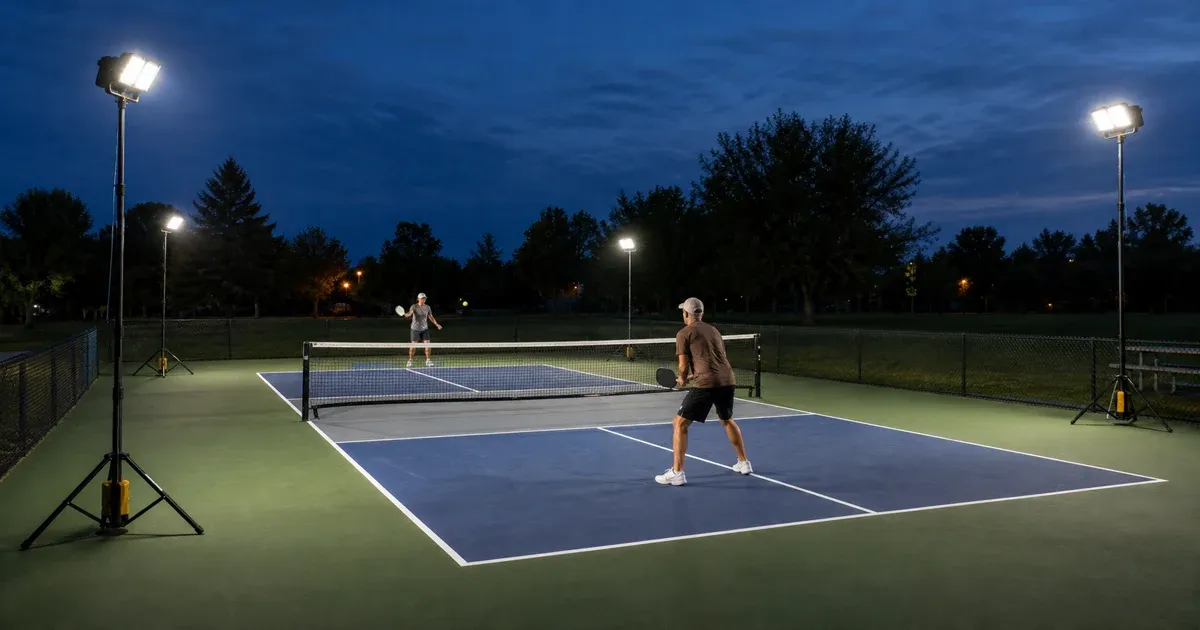
Portable lighting can rescue an evening session, but brightness printed on a box does not guarantee a playable court. A low tripod creates glare and long shadows; one powerful lamp leaves the far baseline dim; and a lightweight stand can become unsafe when the wind rises.
For organised full-court play, the Ritelite Sports-LITE 4 Kit is the best starting point because it combines four battery-powered light heads, 3 m (9.8 ft) tripods and beam control intended for court sports. The Eversun Apollo S Pickleball Court Lighting Package is the higher-output choice for clubs, while the Tresda Rechargeable Telescopic Camping Light is a far more portable answer for drills and casual half-court play.
The five best portable pickleball lighting options at a glance
Ritelite Sports-LITE 4 Kit
Four focused, battery-powered court lights provide more balanced coverage than one dazzling lamp. The kit is built for sports organisations that need repeatable setup and pack-away operation.
Tresda Rechargeable Telescopic Camping Light
Lightweight, rechargeable and quick to raise, this 3,000-lumen lamp suits driveway drills or a lit practice zone. It is not a one-light solution for competitive full-court doubles.
CONPEX 25000LM Telescopic Camping Light
High output and an IP67-rated head make this a useful semi-portable option when you already own a suitable 12 V power source and can secure the stand properly.
Eversun Apollo S Pickleball Court Lighting Package
Two tall, high-output portable towers are designed to cover a complete court. This is club equipment rather than something one player casually carries in a shoulder bag.
DEWALT DCL079R1 20V MAX Cordless Tripod Light
A robust, self-contained tower for a training zone, sideline or supplementary fill light, especially if you already use compatible batteries. Multiple units are required for useful court coverage.
What makes a portable light suitable for pickleball?
Coverage beats headline lumens
Pickleball requires you to see a small perforated ball travelling across the complete 44 by 20 ft (13.4 by 6.1 m) playing area, plus the surrounding run-off. Two or four moderately bright lights positioned around the court usually produce fewer dark patches than one intense source.
Treat unverified lumen claims cautiously. Beam shape, mounting height and aiming determine how much light reaches the surface and whether it is distributed evenly.
Height helps control glare and shadows
A lamp close to eye level may make the ball disappear as it crosses the beam. Taller stands can direct light down and across the playing area, but they also need a wider, ballasted footprint. Never place a tripod where a player could run into it, and do not extend it fully in wind unless the manufacturer provides an approved anchoring method.
Battery runtime needs margin
A quoted maximum runtime often applies at a lower brightness setting. Plan for warm-up, delays between games and gradual battery ageing rather than matching the advertised runtime exactly to your booking. Removable batteries are useful for clubs because a depleted pack does not end the session.
Weather resistance is not wind resistance
An IP rating describes protection against dust and water under defined conditions; it does not promise that a tall stand will remain stable in a gust. Check both the light head and its battery connections, keep chargers dry and stop play when weather makes the installation unsafe.
1. Ritelite Sports-LITE 4 Kit: balanced coverage for regular sessions
The Ritelite Sports-LITE 4 Kit approaches the problem as court lighting rather than as a repurposed work lamp. Four IP65 light heads and four 3 m (9.8 ft) tripods allow illumination from several angles, reducing the harsh central shadow created by a single tower.
Ritelite uses focused beam control to keep more light on the playing area and reduce spill towards neighbouring properties. The rechargeable, removable batteries are rated for up to four hours and 20 minutes, depending on use, and the kit includes transport bags. Those details matter when volunteers must move, deploy and count the equipment every week.
Four tripods demand clear space beyond the run-off zone, and this is still training and recreational lighting rather than a substitute for a professionally designed permanent installation. For a club or group that repeatedly converts an unlit court, however, the complete system is easier to manage than assembling unrelated lamps, stands and battery packs.
2. Tresda Rechargeable Telescopic Camping Light: the practical drill light
Not every evening session needs a regulation court illuminated from baseline to baseline. The Tresda Rechargeable Telescopic Camping Light is useful when you want to practise serves, dinks or wall drills in one defined area.
It extends to 8.4 ft (2.56 m), provides a claimed maximum of 3,000 lumens and offers adjustable brightness and colour temperature. At about 4.7 lb (2.1 kg), it is easy for one person to carry and quick to put away. Its IP65 rating also makes it less vulnerable to dust or a brief shower than an indoor lamp.
That portability comes with a narrow safety envelope. The output and height are modest for a whole court, and the light stand needs sensible ballast away from player movement. Two units can improve a driveway setup, but players seeking proper doubles coverage should move to a multi-light court system rather than multiplying small lamps indefinitely.
3. CONPEX 25000LM Telescopic Camping Light: high output if power is already solved
The CONPEX 25000LM Telescopic Camping Light appeals to groups that already have a suitable 12 V battery or portable power arrangement. Its five-panel head spreads a claimed 25,000 lumens, the mast reaches roughly 8.8 ft (2.7 m), and the lamp assembly carries an IP67 rating.
The ability to aim several panels can create a broader pool of light than a single fixed beam. Positioning two lights on opposite sides of a practice area should also soften shadows compared with putting all the output behind one baseline.
The external power requirement is the catch. Cables, connectors and batteries must be protected from feet, balls and weather, and the stand remains low compared with a proper court tower. This is a flexible component for a technically confident organiser, not an all-in-one kit that should be handed to volunteers without a setup plan.
4. Eversun Apollo S Pickleball Court Lighting Package: for clubs needing a full-court solution
The Eversun Apollo S Pickleball Court Lighting Package is the option here that most closely resembles temporary sports infrastructure. Its two towers extend to 20 ft (6.1 m), with a published combined output of up to 80,000 lumens and four to ten hours of operation depending on the chosen setting.
That height sends light down onto the court rather than directly across a player's sightline. Eversun offers free-standing bases and fence-mount arrangements, giving a venue alternatives where large tripod footprints would interfere with run-off space.
Each tower is substantial, and the setup needs level ground, correct anchoring and an organiser who understands the manufacturer's wind guidance. It is excessive for a driveway hit. For a club extending evening play on courts without permanent floodlights, its coverage, battery system and purpose-built format justify consideration.
5. DEWALT DCL079R1 20V MAX Cordless Tripod Light: convenient within an existing battery system
The DEWALT DCL079R1 20V MAX Cordless Tripod Light is not sold as dedicated court lighting, but its integrated tripod, cordless operation and established battery platform make it a practical training light. The mast reaches 7 ft (2.13 m), the head can be directed where needed, and the maximum published output is 3,000 lumens.
It works best beside a ball machine, at a dinking station or as fill light for a dark corner of an otherwise illuminated court. A folding body and robust carry handle make it easier to transport than a separate work light and stand.
One unit is not enough for safe full-court play, and buying several only makes sense if battery compatibility already reduces the cost and charging burden. Also confirm the exact battery and charger bundle for your region, as tool-platform packages vary. Choose it for modular convenience, not because a familiar professional-tool badge changes the physics of court coverage.
Which portable pickleball lights should you buy?
- Choose the Ritelite Sports-LITE 4 Kit for regular group sessions where balanced, repeatable court coverage matters.
- Choose the Tresda Rechargeable Telescopic Camping Light for a driveway, dinking station or ball-machine lane.
- Choose the CONPEX 25000LM Telescopic Camping Light if you already have safe 12 V power and want adaptable high-output lights.
- Choose the Eversun Apollo S Pickleball Court Lighting Package when a club needs purpose-built temporary full-court illumination.
- Choose the DEWALT DCL079R1 20V MAX Cordless Tripod Light for supplementary lighting within an existing compatible tool-battery setup.
Mistakes that make night play less safe
Putting every light behind one baseline
This creates severe shadows and makes the ball difficult to follow when players change ends. Spread lights along both sides where possible, keep them beyond the run-off and aim them so players do not look directly into the beam during overheads.
Trusting brightness mode to compensate for poor placement
Turning one low light to maximum often increases glare without fixing dark zones. Raise and distribute lights, then use the lowest setting that gives even, comfortable visibility.
Leaving tripods unmarked
Place stands well outside the playing area, use the approved ballast or anchors and make legs visible in low light. Cables should be covered or routed completely away from any path used by players and spectators.
Frequently asked questions
How many portable lights are needed for a pickleball court?
For full-court play, plan around several lights rather than one. Four smaller purpose-built court lights or two tall, high-output towers are common portable layouts, but the correct number depends on beam pattern, mounting height, surrounding light and required playing standard.
Is 3,000 lumens enough for pickleball?
It can be enough for a compact drill area, wall practice or supplementary fill light. It is not a credible single-source solution for even illumination across a regulation court and its run-off area.
Can portable work lights be used for night pickleball?
Yes, for practice or as part of a carefully arranged multi-light setup. Keep lamps above eye level where possible, secure every stand, protect cables and batteries, and stop if glare or dark patches prevent players from tracking the ball confidently.
What colour temperature is best for a pickleball court?
A neutral to cool white light generally makes a bright ball easy to distinguish, but uniformity and glare control matter more than choosing the highest colour-temperature number. Matching all lights also avoids distracting colour changes across the court.
Are IP65 lights safe to leave outside?
IP65 indicates resistance to dust and water jets under test conditions, not permission to leave the complete system outdoors indefinitely. Connections, chargers and batteries may have different ratings, and wind can make an extended tripod unsafe even when the lamp is water-resistant.
Our final pick
The Ritelite Sports-LITE 4 Kit is the best portable pickleball court lighting choice for most organised night sessions. Four purpose-built, rechargeable lights provide a more balanced and manageable layout than one oversized beam. For individual drills, spend less and carry less with the Tresda Rechargeable Telescopic Camping Light; for club-grade temporary coverage, step up to the Eversun Apollo S Pickleball Court Lighting Package.
Our editorial process
How we research and review our content
Our research process depends on the subject. We select the sources that can answer the article's actual question, cross-check important claims, and distinguish documented facts from editorial judgement.
- Practical context and direct experience
- We draw on our team's experience of sports, equipment, and organising competitions when it is relevant. Direct use informs our judgement only where it actually occurred; we do not present research as hands-on testing.
- Primary and authoritative sources
- Depending on the topic, we consult governing-body rules, official guidance, manufacturer specifications and manuals, standards, technical documentation, and other first-party sources.
- Independent and public evidence
- For comparisons and recommendations, we may examine specialist reviews, public customer feedback, retailer information, ratings, and recurring real-world issues. We cross-check patterns and never treat one comment or score as proof.
- Editorial review and updates
- We compare the available evidence with the reader's likely needs, explain uncertainty and trade-offs, verify important claims, and update content when rules, products, features, or source information change.
Share this article
Send this guide to someone who might find it useful.

About the author
Fixture.cc editorial team
The Fixture.cc editorial team is a global group of sports enthusiasts creating practical, trustworthy guides for sports fans, competition organisers, coaches, and teachers.
View editorial profileKeep reading
Related articles
Best Cameras for Recording Youth Football Matches in 2026
Five cameras for filming youth football from the sideline, chosen for battery life, wide field of view, stabilization, and standing up to a wet touchline.
5 Best Pickleball Paddles for Every Playing Style
Five current pickleball paddles for control, value, quick handling, power and premium play, with practical advice on choosing the right shape.
5 Best Budget Gaming Monitors Under USD 200 for Esports
Five gaming monitors under USD 200 with refresh rates and response times suited to competitive esports, from compact displays to 1440p options.