5 Best Portable PA Speakers Under $60 in 2026
Five budget speakers and megaphones under $60 that are actually loud enough to announce scores and calls across a five-a-side pitch or sports hall.
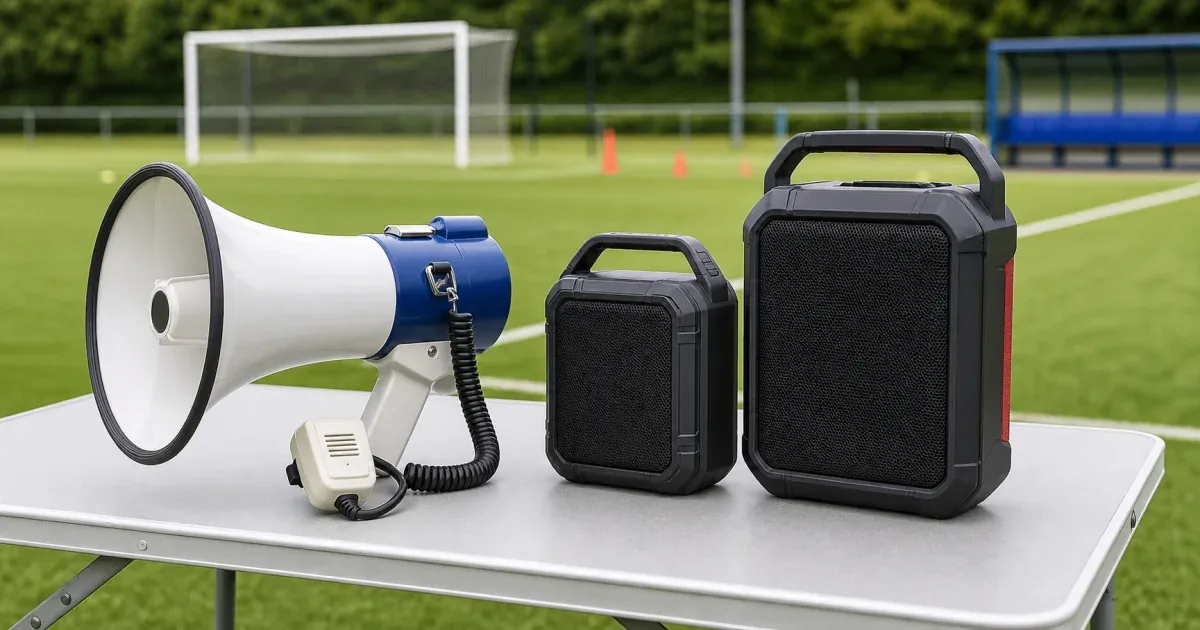
Most organisers buy the wrong kind of speaker first.
A budget Bluetooth speaker, the kind that costs around $40 USD (and roughly the equivalent in GBP, CAD or AUD on your local Amazon), sounds great on a kitchen counter. Take it outside to a full-size five-a-side pitch and it disappears the moment a game gets loud. It also has no way to plug in a microphone, which is the actual feature most tournament days need: someone shouting "next match on court two" over twenty players, two other games and a parking area full of parents.
The two jobs are genuinely different. If you need to speak live over a game, you want a megaphone with a built-in microphone, not a party speaker. If you only need background music, warm-up playlists or a pre-recorded announcement, a normal portable speaker is fine, and often cheaper.
For most organisers running weekend fixtures, we would start with the Pyle PMP42BT Bluetooth Megaphone Bullhorn. It does both jobs adequately for under $60, with a proper handheld mic for live announcements and Bluetooth for music between matches. If you would rather not deal with disposable batteries, the Pyle PMP48IR is the better pick. And if all you actually need is louder music at the bench, the Anker Soundcore 3 covers more ground than either megaphone.
Here are the five options worth considering, all comfortably under $60 USD on most Amazon marketplaces.
The five options worth considering
Pyle PMP42BT Bluetooth Megaphone Bullhorn
The safest all-rounder for live announcements and music, with a real handheld mic and Bluetooth streaming in one unit.
Pyle PMP48IR Rechargeable Megaphone
A cheaper megaphone that skips Bluetooth streaming for a proper rechargeable battery, with disposable D-cells kept only as a backup.
JBL Clip 4
Clips onto a bag or goal net for background music between games, at the cost of any way to plug in a microphone.
Anker Soundcore 3
The loudest, longest-lasting option here for filling a full outdoor venue with music rather than a live voice.
JBL Go 3
The cheapest, smallest backup speaker for a single table or court, not a main PA for anyone.
What actually matters when buying one of these
Do you need to speak, or just play sound?
This is the question that decides everything else. A megaphone with a wired mic lets someone shout over a full pitch without straining their voice. A Bluetooth speaker, however loud, only plays whatever is already on a phone. Neither one is a worse product; they solve different Saturday mornings.
Battery type matters more than the spec sheet suggests
Rechargeable lithium batteries are convenient until they run flat halfway through a six-hour tournament and there is no wall socket near the pitch. A megaphone that also accepts disposable D-cell batteries as a backup, or runs on them by default, is genuinely more reliable for an all-day event, even if it feels old-fashioned next to a USB-C speaker.
Weatherproofing is not optional outdoors
An IP67 rating means a speaker survives rain and a dusty parking area; a paper spec sheet does not. None of the megaphones here are properly weatherproof, so keep them under cover between announcements if rain is forecast, and treat the Bluetooth speakers' waterproof ratings as a genuine reason to prefer them for a wet Sunday league.
Real coverage is smaller than the marketing range
A "1,000-yard range" (roughly 900 metres) on a megaphone box describes how far a straight line of sound theoretically carries in ideal conditions, not how clearly it is understood over background noise, wind and other games. Treat these figures as a rough ranking between models, not a distance you can rely on at your actual venue.
1. Pyle PMP42BT Bluetooth Megaphone Bullhorn: the one we would recommend to most organisers
This is a real megaphone built for exactly this job, not a repurposed party speaker. It puts out 40 watts through an integrated wired handheld mic, with a separate siren button for grabbing attention before an announcement, and Bluetooth streaming so you can play music or a walk-on track through the same unit.
The pistol-grip design keeps it comfortable to hold through a full afternoon of announcements, and the 3.5mm aux and SD/USB inputs mean you are not stuck relying on a Bluetooth connection if it drops. The obvious catch is the power source: it runs on six D-cell batteries with no rechargeable option, so budget for a fresh set before a long tournament day rather than assuming a top-up charge overnight will be enough.
For a five-a-side league, a school sports day or a weekend tournament where one person handles both the scoreboard and the announcements, this is the option that actually replaces shouting.
2. Pyle PMP48IR Rechargeable Megaphone: for organisers who would rather not buy batteries every season
Drop the Bluetooth streaming and the price comes down with it. The Pyle PMP48IR still delivers 40 watts through a wired handheld mic with a siren mode, but it runs on a built-in rechargeable lithium battery, with six D-cell batteries kept as a backup rather than the only option.
That combination suits a venue with power nearby to charge it overnight, or an organiser who is tired of restocking disposable batteries between fixtures. What you lose is the ability to stream music through it between announcements, and the 10-second memory replay function is a novelty rather than something most leagues will use often.
Choose this one over the PMP42BT if you specifically want to avoid buying batteries, and do not mind giving up the Bluetooth music option to get there.
3. JBL Clip 4: easiest to carry between courts
Some tournament days need less power and more portability. The JBL Clip 4 weighs around 240 g (0.53 lb), has a built-in carabiner, and clips straight onto a kit bag, a goal net or a folding table leg without needing a stand or anywhere flat to sit it down.
Its IP67 rating means a sudden downpour or a stray water bottle will not end its afternoon, and roughly 10 hours of playtime covers most single-day events without a recharge. It has no microphone input at all, so it is strictly a music and playlist speaker, not something you can announce through. Its 5-watt output is also noticeably quieter than the other speakers here once you are more than a few metres (10 feet or so) away.
It earns its place as the one you actually remember to bring, because it takes up almost no space in an equipment bag.
4. Anker Soundcore 3: the most sound for the space
Where the JBL options are built around portability, the Anker Soundcore 3 is built around output. Its two 8-watt drivers push noticeably further across an open pitch or a busy hall than a compact clip speaker, and a rated 24-hour battery life means it will comfortably outlast a full day of matches on a single charge.
It carries an IPX7 rating, so rain or a splash from a water bottle is not a concern, and the companion app's bass and EQ adjustment makes recorded walk-on music or a warm-up playlist sound noticeably fuller than on a smaller speaker. It has no microphone input, the same limitation as the JBL models, so pair it with a phone's voice memo or a pre-recorded announcement if you need to speak through it rather than expecting to plug in a mic.
Pick this one when the priority is genuinely loud, long-lasting music across an outdoor venue rather than live announcements.
5. JBL Go 3: the cheapest backup worth keeping in the bag
The smallest and least expensive speaker in this list is not meant to be anyone's main PA. At 4.2 watts and around 5 hours of battery life, the JBL Go 3 is genuinely quiet next to the Soundcore 3 or either megaphone, and it will struggle to be heard over a game in progress.
What it does well is exist as a second speaker that costs little enough to leave permanently in a registration table bag. It is IP67 rated, fits in a coat pocket, and is loud enough for a quiet corner, a single indoor court, or background music at a sign-up desk away from the main action.
Buy this as a spare for a small venue or a second table, not as a replacement for the main speaker or megaphone.
So, which one should you buy?
For most organisers running a five-a-side league or a weekend tournament, the Pyle PMP42BT is the easiest answer, because it is the only option here built specifically to let one person announce, alert and play music from a single device.
If battery logistics matter more to you than the Bluetooth streaming, choose the Pyle PMP48IR instead. If announcements are not the point and you just need better music across a bigger venue, the Anker Soundcore 3 is the stronger buy. The JBL Clip 4 and JBL Go 3 make more sense as a secondary speaker than a main one.
A quick way to decide:
- If you need to shout over a live game regularly, choose the Pyle PMP42BT.
- If you want a megaphone without buying batteries every season, choose the Pyle PMP48IR.
- If you just want loud, long-lasting music across the whole venue, choose the Anker Soundcore 3.
- If you want something small enough to always have in the bag, choose the JBL Clip 4 or JBL Go 3.
A few mistakes worth avoiding
Assuming a music speaker will work as a PA
A Bluetooth speaker cannot announce anything on its own. Unless it has a genuine microphone or line-in input, plugging a phone into a call or voice memo app and holding it near the speaker is the only workaround, and it sounds exactly as bad as it seems.
Buying on wattage alone
A 50-watt megaphone with a poor microphone can sound worse than a 40-watt model with a clearer one. Look at what reviewers say about voice clarity, not just the number printed on the box.
Forgetting the batteries
A megaphone that runs on D-cell batteries is only reliable if you actually bring spares. Keep a set in the same bag as the megaphone itself, not in a drawer at home.
Frequently asked questions
Can I use a normal Bluetooth speaker to announce scores?
Only if it has a microphone or aux input you can talk through, and most compact Bluetooth speakers do not. If you regularly need to speak live over a game, a megaphone with a built-in mic is the more reliable tool.
How loud does a PA speaker actually need to be for a five-a-side pitch?
A 40-watt megaphone is normally enough for a single pitch or court, since the mic does most of the work of carrying a voice over background noise. Larger venues with multiple pitches running at once benefit from more power or a second unit.
Is a rechargeable megaphone better than one that uses batteries?
It depends on your venue. Rechargeable batteries are convenient where mains power is available overnight, while disposable D-cell batteries are more dependable for an all-day event with no charging point nearby.
Do these speakers work indoors as well as outdoors?
Yes, and indoor sports halls are usually easier on a speaker than an open pitch, since walls help carry the sound rather than letting it dissipate. The weatherproof ratings on the Bluetooth speakers only matter for outdoor use.
Our final pick
The Pyle PMP42BT Bluetooth Megaphone Bullhorn is the best default for most tournament and league organisers, because it is the only product here that genuinely replaces shouting across a pitch while also covering music between matches. Everything else on this list is a better fit for a specific situation: fewer batteries to buy, more raw volume for music, or a smaller backup speaker worth keeping in the bag.
Our editorial process
How we research and review our content
Our research process depends on the subject. We select the sources that can answer the article's actual question, cross-check important claims, and distinguish documented facts from editorial judgement.
- Practical context and direct experience
- We draw on our team's experience of sports, equipment, and organising competitions when it is relevant. Direct use informs our judgement only where it actually occurred; we do not present research as hands-on testing.
- Primary and authoritative sources
- Depending on the topic, we consult governing-body rules, official guidance, manufacturer specifications and manuals, standards, technical documentation, and other first-party sources.
- Independent and public evidence
- For comparisons and recommendations, we may examine specialist reviews, public customer feedback, retailer information, ratings, and recurring real-world issues. We cross-check patterns and never treat one comment or score as proof.
- Editorial review and updates
- We compare the available evidence with the reader's likely needs, explain uncertainty and trade-offs, verify important claims, and update content when rules, products, features, or source information change.
Share this article
Send this guide to someone who might find it useful.

About the author
Fixture.cc editorial team
The Fixture.cc editorial team is a global group of sports enthusiasts creating practical, trustworthy guides for sports fans, competition organisers, coaches, and teachers.
View editorial profileKeep reading
Related articles
Best Cameras for Recording Youth Football Matches in 2026
Five cameras for filming youth football from the sideline, chosen for battery life, wide field of view, stabilization, and standing up to a wet touchline.
5 Best Pickleball Paddles for Every Playing Style
Five current pickleball paddles for control, value, quick handling, power and premium play, with practical advice on choosing the right shape.
5 Best Budget Gaming Monitors Under USD 200 for Esports
Five gaming monitors under USD 200 with refresh rates and response times suited to competitive esports, from compact displays to 1440p options.