5 Best Football Rebounders for Solo Training in 2026
Five football rebounders for solo passing, first-touch and reaction training, with clear advice on rebound style, size, stability and storage.
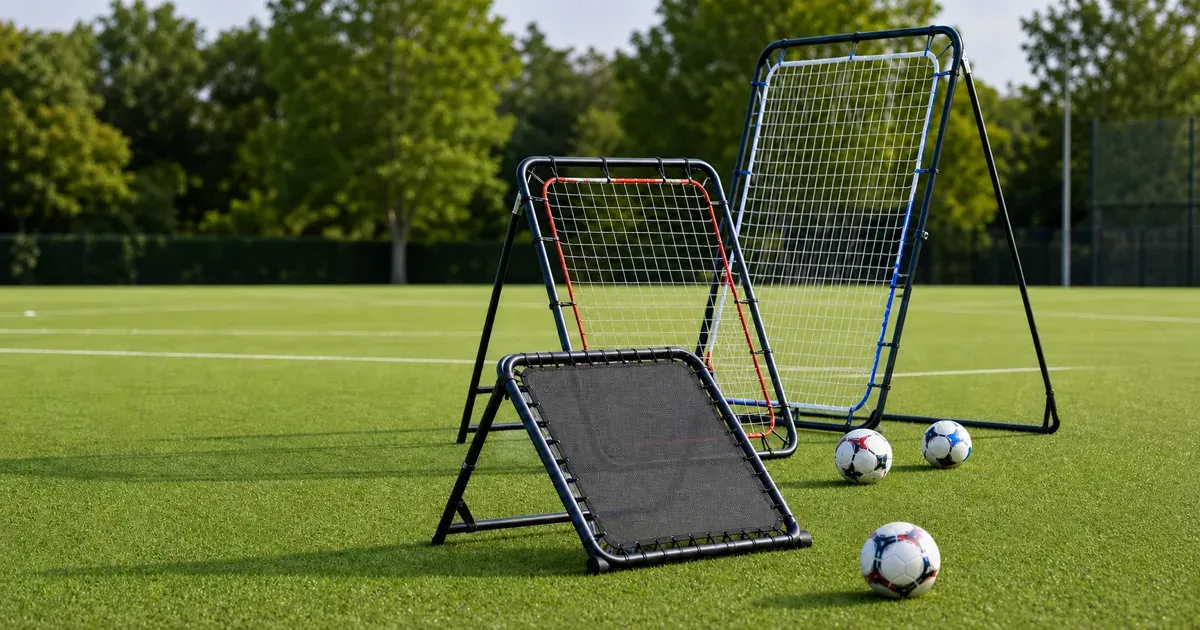
Solo football training becomes much more useful when the ball comes back quickly enough to keep you moving. A poor rebounder rolls the ball back slowly, shifts after every firm pass or sends every return in the same comfortable direction.
For most players, the QUICKPLAY REPLAY Station 4-in-1 Football Rebound Board is the best place to start. It is compact, quick to set up and can produce either predictable or awkward returns depending on which face and angle you use.
Players who want ground passes and higher returns from one larger frame should consider the SKLZ Quickster Soccer Trainer. Younger players and beginners may get more useful repetitions from the broader, softer return of the QUICKPLAY SPOT Football Rebounder 8 x 5 ft.
The best football rebounders at a glance
QUICKPLAY REPLAY Station 4-in-1 Football Rebound Board
The best all-round choice for most solo players and small spaces
SKLZ Quickster Soccer Trainer
The best for combining ground passes with aerial first-touch practice
QUICKPLAY SPOT Football Rebounder 8 x 5 ft
The most forgiving large target for children and beginners
Franklin Sports Adjustable Soccer Rebounder 6 x 4 ft
The sensible traditional adjustable net for a grass garden
Tekk Pro Edition Soccer Trainer Rebounder
The premium choice for powerful, heavy-use training
What should you look for in a football rebounder?
A larger rebounder is not automatically better. The right choice depends on the return you need, where you train and how often you are willing to assemble or move the frame.
Decide between a board and a net
A solid rebound board usually returns a ground pass quickly and consistently. It is excellent for one-touch passing, opening your body before receiving and reacting to a ball that comes back with purpose.
Boards are also compact. They suit patios, small gardens and tight training areas where an 8 ft net would be awkward.
The downside is the smaller target. A slightly inaccurate pass may miss completely, which can interrupt a beginner's rhythm. A hard board can also be noisier than a net when used close to neighbours.
A net gives you a larger striking area and more options for lofted returns, volleys, chest control and goalkeeper work. Net tension matters, though. A loose net absorbs the ball and drops it nearby, while a tighter or bungee-mounted net produces a quicker return.
Match the return to the skill you want to train
For short passing, the ball should come back along the ground or at a low, controllable height. A return that jumps waist-high after every pass is frustrating when you are trying to practise receiving across your body.
For first-touch and aerial work, some variation is useful. You need returns that ask you to use the inside of the foot, laces, thigh or chest rather than repeating the same easy touch.
Goalkeepers and advanced players normally benefit from a faster rebound and adjustable angles. Children often learn more from a slower, looped return that gives them enough time to move their feet and prepare properly.
Measure the space, including the depth
The advertised width and height do not tell you how much room the rebounder needs.
Angled nets extend backwards. Support legs, stabilizing bars and sandbags add depth. You also need enough distance in front to pass firmly without standing on top of the frame.
Measure the complete training area before ordering. A compact board may be the more useful purchase if a large frame has to be dismantled after every ten-minute session.
Think about stability before rebound speed
A rebounder cannot return the ball consistently if it slides, rocks or lifts.
Ground stakes work well on natural grass but cannot help on concrete, indoor flooring or many artificial surfaces. Hard-surface training may require integrated weight, rubber feet or separate base weights.
Do not assume the frame's own weight will be enough. A firm adult pass carries far more force than a gentle demonstration in a product video.
Check how it stores
The rebounder you can deploy in a minute is more likely to be used than one buried behind garden furniture.
Look for folding legs, a carry bag, pre-attached sections and tool-free assembly. Large steel frames may be durable, but they can become permanent garden equipment simply because moving them is inconvenient.
Replacement nets and bungees also matter. The frame may last for years, while an exposed net eventually suffers from weather, friction and repeated impact.
1. QUICKPLAY REPLAY Station 4-in-1 Football Rebound Board: the best choice for most solo players
The QUICKPLAY REPLAY Station 4-in-1 Football Rebound Board makes solo practice easy to begin and difficult to fake.
One side is flat, giving you the clean return needed for repeated passing patterns. The other is ribbed, so the ball can kick away at less convenient angles. You can also change the orientation to alter the height and type of rebound.
That combination is more useful than simply hitting one hundred identical passes against a wall. Start with the flat face and work on receiving with your back foot. Then turn the panel around and force yourself to adjust after the ball changes direction.
The assembled unit is approximately 95 cm wide and weighs a little over 6 kg. It folds flat, uses weighted steel support legs and includes a sandbag for extra stability. That makes it practical for a small garden, a patch of artificial turf or a corner of the training ground.
Its size is also its limitation. Poorly directed passes miss the panel, and it cannot recreate the broad aerial service of a full rebound net. Beginners who spend more time collecting the ball than controlling it may prefer a larger target.
For an adult player who wants short, focused sessions, however, the compact format is a strength. Ten minutes of one-touch passes, weak-foot receives and random-return reactions can fit into a small space without a lengthy setup.
2. SKLZ Quickster Soccer Trainer: the best for ground and aerial first touch
The SKLZ Quickster Soccer Trainer is built around two related problems: returning a pass cleanly along the ground and sending the ball back at a useful height for volleys or controlled first touches.
Its low section produces a true-roll return for passing and receiving. The larger raised net lets you practise instep volleys, half-volleys and settling the ball from the air.
That makes it a better all-session trainer than a simple flat net. You can begin with five minutes of two-touch passing, move to one-touch layoffs and then work on taking a higher return away from pressure.
The larger target is helpful when your accuracy is still developing. It also allows you to change distance and pass with more pace without turning every small mistake into a walk across the garden.
The flexible, portable frame sets up quickly and is easier to move than a permanent steel rebound wall. It is still a considerably larger object than a low rebound board, so check the available width and storage space.
Its returns are designed for technical repetition rather than maximum violence. Players who want goalkeeper reaction work or very hard, game-speed rebounds may prefer the more heavily built Tekk option later in this guide.
For a player trying to improve the first and second touch - not merely kick the ball as hard as possible - the dual-return design is the reason to buy it.
3. QUICKPLAY SPOT Football Rebounder 8 x 5 ft: the best large target for beginners
A young player does not need every return to arrive at match speed. They need enough successful repetitions to develop a reliable movement.
The QUICKPLAY SPOT Football Rebounder 8 x 5 ft uses a broad face and a loop-pass return that gives the player time to prepare. The ball stays in the exercise without firing back so sharply that every touch becomes an emergency.
Its 8 x 5 ft (2.4 x 1.5 m) target is forgiving when passing accuracy is inconsistent. The steel base provides structure, while the fibreglass uprights flex when struck. QUICKPLAY lists a tool-free setup of under two minutes and a carry weight of approximately 8 kg.
On grass, four included anchors secure the frame. Hard surfaces require more thought because the anchors cannot be used; a suitable base weight is the sensible addition for artificial turf, concrete or indoor training.
The softer return is not ideal for every player. An experienced adult may eventually want more pace and a less predictable response. The generous target can also hide sloppy passing if every drill is performed from close range.
Use the size properly. Mark a smaller target area with tape or cones, increase the distance and alternate feet. The large net then gives you room to progress without punishing every imperfect attempt.
This is the rebounder we would choose for a child, a complete beginner or a family that wants a net everyone can use.
4. Franklin Sports Adjustable Soccer Rebounder 6 x 4 ft: the sensible adjustable net
The Franklin Sports Adjustable Soccer Rebounder 6 x 4 ft follows the traditional rebounder design: a powder-coated steel frame, bungee-mounted all-weather net and adjustable angle.
That sounds basic, but basic can be useful. Changing the angle lets you move between lower passing returns and higher balls for trapping, volleys or heading. The 6 x 4 ft (1.8 x 1.2 m) face is large enough for meaningful repetitions without taking over a normal garden.
The frame uses 1.25-inch steel tubing, locking pins and four galvanised ground stakes. It is therefore best suited to grass, where the stakes can do their job.
The main buying question is not whether it offers enough drills. It is whether you want to assemble, position and secure a conventional steel net each time you train. It is less elegant to store than a small board and less forgiving to move than a flexible portable frame.
In return, you get a straightforward piece of equipment without paying for an oversized professional structure. It works for passing, receiving and mixed family use, and the adjustable face provides more variety than a fixed vertical net.
Buy it when you have a suitable patch of grass and want a normal adjustable rebounder at a sensible level. Choose a weighted board instead when most of your training happens on a patio or artificial surface.
5. Tekk Pro Edition Soccer Trainer Rebounder: the premium option for powerful returns
The Tekk Pro Edition Soccer Trainer Rebounder is not the rebounder to buy for occasional ten-minute kickabouts.
Its one-piece aluminium frame, 3 mm steel brackets and bungee-hooked net are intended to produce a quick return and withstand frequent, forceful use. The training face covers 40 square feet and can be adjusted through seven positions.
That opens up far more than short passing. Outfield players can work on side volleys, striking, heading, thigh control and finishing after the first touch. Goalkeepers can use the angle and rebound speed for catching, footwork and diving exercises.
The heavy construction helps the frame stay composed under firm contact. It also makes the trainer far less convenient to carry and store than a flexible net or small board. At 48 x 72 x 96 inches, this is portable in the sense that it folds and can be moved - not in the sense that a child will casually carry it to the park.
It is also expensive. Most players will improve more by training consistently with a cheaper rebounder than by owning a professional-looking frame they rarely unfold.
The premium makes sense for a serious household with several players, a goalkeeper, a coach running repeated stations or someone who wants one rebounder to last through years of hard use.
For everyone else, the compact QUICKPLAY board or the dual-return SKLZ trainer offers a better balance of capability and convenience.
Which football rebounder should you buy?
For most solo players, buy the QUICKPLAY REPLAY Station 4-in-1 Football Rebound Board. It is easy to deploy, works in a small space and gives you both controlled and awkward returns.
Choose differently when your training has a clearer priority:
- For ground passing and aerial first-touch practice in one frame, choose the SKLZ Quickster Soccer Trainer.
- For children, complete beginners and a large forgiving target, choose the QUICKPLAY SPOT Football Rebounder 8 x 5 ft.
- For an adjustable traditional net on grass, choose the Franklin Sports Adjustable Soccer Rebounder 6 x 4 ft.
- For powerful returns, goalkeeper drills and long-term heavy use, choose the Tekk Pro Edition Soccer Trainer Rebounder.
Do not buy around the most ambitious drill you might perform once. Buy for the session you can repeat three times a week.
A simple solo rebounder session
A rebounder is most useful when the drill has a purpose. Kicking continuously without controlling the distance, body position or target can simply reinforce rushed technique.
Try this 20-minute sequence:
- Four minutes of two-touch passing: Receive with one foot and pass with the other. Move the first touch outside your body rather than stopping the ball underneath you.
- Four minutes on the weaker foot: Use only the weaker foot for receiving and passing. Reduce the distance if your technique begins to collapse.
- Four minutes of one-touch returns: Keep the passes controlled. Count the longest clean sequence rather than striking harder after every repetition.
- Four minutes of open-body receiving: Start slightly side-on, scan over one shoulder before the ball returns and take the first touch across your body.
- Four minutes of varied returns: Change the rebound angle, use an irregular surface or alternate ground and aerial service.
Rest briefly when the quality drops. One hundred deliberate touches are more useful than five hundred tired ones.
Football rebounder mistakes to avoid
Buying a net that is too large to leave assembled
A large target looks useful online. It becomes less useful when every session starts by moving boxes, joining poles and finding the missing ground stake.
Choose the largest rebounder that fits your normal training space without becoming a household project.
Failing to secure the frame
Sliding frames produce inconsistent returns and can tip after harder contact. Use every supplied stake on grass and the correct weight system on hard surfaces.
Do not improvise with unstable objects resting against the frame.
Training only the dominant foot
The rebounder will happily send every pass back to the same comfortable side. Change your starting angle, move after each pass and schedule dedicated weaker-foot blocks.
Standing still after passing
Football does not stop while you admire a pass. Shift sideways, check a shoulder, open your hips or move around a cone before receiving the return.
Even a basic rebounder becomes more match-relevant when you add movement.
Treating maximum rebound speed as maximum quality
A return that is too fast for your current technique encourages stabbing touches and poor posture. Begin at a distance and pace that allow correct movement, then increase the difficulty.
Frequently asked questions
Are football rebounders good for solo training?
Yes. They let you repeat passing, receiving, first-touch and reaction exercises without another player. They are most effective when you vary the angle, distance, foot and movement rather than repeating one comfortable pass.
Is a rebound board better than a rebound net?
A board is normally better for fast ground passing, compact storage and predictable returns. A net offers a larger target and more options for aerial control, volleys and goalkeeper drills. The better choice depends on the skill and space, not the price.
What size rebounder is best for a garden?
A compact board suits a small patio or narrow garden. A 6 x 4 ft (1.8 x 1.2 m) net is a useful middle ground for most gardens, while an 8 x 5 ft (2.4 x 1.5 m) target gives beginners more room for error. Measure the frame's depth and your passing distance as well as its width.
Can I use a football rebounder on artificial turf or concrete?
Usually, but check how the model is stabilised. Ground stakes cannot be used on concrete and may not be suitable for artificial turf. Use the manufacturer's compatible base weight, sandbag or hard-surface stabilisation system.
Can a rebounder improve first touch?
It can provide the repetitions needed to improve first touch, but the equipment does not correct technique by itself. Work on body shape, scanning, receiving direction and using both feet. Change the rebound angle so the exercise does not become completely predictable.
Our final pick
The QUICKPLAY REPLAY Station 4-in-1 Football Rebound Board is the best football rebounder for most solo training. It is compact enough to use regularly, stable enough for firm technical work and varied enough to train more than one comfortable passing pattern.
The SKLZ Quickster Soccer Trainer is the better purchase when aerial first touch is a priority. The QUICKPLAY SPOT Football Rebounder 8 x 5 ft is easier for children and beginners, while the Tekk Pro Edition Soccer Trainer Rebounder is justified only when powerful, frequent training matters more than price and portability.
Whichever design you choose, leave enough room to move, secure the frame properly and train the touch after the pass - not only the pass itself.
Our editorial process
How we research and review our content
Our research process depends on the subject. We select the sources that can answer the article's actual question, cross-check important claims, and distinguish documented facts from editorial judgement.
- Practical context and direct experience
- We draw on our team's experience of sports, equipment, and organising competitions when it is relevant. Direct use informs our judgement only where it actually occurred; we do not present research as hands-on testing.
- Primary and authoritative sources
- Depending on the topic, we consult governing-body rules, official guidance, manufacturer specifications and manuals, standards, technical documentation, and other first-party sources.
- Independent and public evidence
- For comparisons and recommendations, we may examine specialist reviews, public customer feedback, retailer information, ratings, and recurring real-world issues. We cross-check patterns and never treat one comment or score as proof.
- Editorial review and updates
- We compare the available evidence with the reader's likely needs, explain uncertainty and trade-offs, verify important claims, and update content when rules, products, features, or source information change.
Share this article
Send this guide to someone who might find it useful.

About the author
Fixture.cc editorial team
The Fixture.cc editorial team is a global group of sports enthusiasts creating practical, trustworthy guides for sports fans, competition organisers, coaches, and teachers.
View editorial profileKeep reading
Related articles
Best Cameras for Recording Youth Football Matches in 2026
Five cameras for filming youth football from the sideline, chosen for battery life, wide field of view, stabilization, and standing up to a wet touchline.
5 Best Pickleball Paddles for Every Playing Style
Five current pickleball paddles for control, value, quick handling, power and premium play, with practical advice on choosing the right shape.
5 Best Budget Gaming Monitors Under USD 200 for Esports
Five gaming monitors under USD 200 with refresh rates and response times suited to competitive esports, from compact displays to 1440p options.